
How Google Really Works: Algorithms, Ranking Systems and Updates
The three stages of Search, active and retired ranking systems, what each algorithm solved from PageRank to AI answers, how to read a core update and what to do next.

Eugenio Tommasi
Founder of SEO SRL
Published 25 min read

Google does not use a single algorithm: it crawls and indexes pages, then ranks them with dozens of ranking systems, updated several times a year through core updates.
Table of contents (12 sections)
- There is no single algorithm: the four layers that decide results
- The three stages: crawling, indexing, serving results
- The ranking systems Google documents: active and retired
- From PageRank to AI answers: what each algorithm solved
- Core updates and spam updates: how to recognize them
- What to do when an update arrives
- Quality raters: what they do and what they don't
- E-E-A-T and helpful content: what the systems really reward
- AI Overviews and AI Mode: what they change for clicks
- Official sources, patents and leaked documents: telling facts from hypotheses
- What follows for anyone with a website
- Frequently asked questions
People talk about “the Google algorithm” as if it were a single, secret formula that changes now and then. It is not. Google ranks results with dozens of different systems, built in different years to solve different problems, and it documents a good part of them in public.
This guide is the map: the three stages Google applies to every page, the active and retired ranking systems, what each historical algorithm solved, how to read a core update, what quality raters do and what AI answers change. Each topic links to the chapter that covers it in depth. It is written for anyone who runs a website and wants to understand why traffic moves, without chasing rumors.
There is no single algorithm: the four layers that decide results
When someone asks me “how did the algorithm change?”, the first thing I do is work out which layer they mean. The word “algorithm” covers four different things, which move at different speeds.
| Layer | What it is | How often it changes | Where to read about it |
|---|---|---|---|
| The stages | Crawling, indexing and serving results: the path every page follows | Almost never, in substance | Google's guide to how Search works |
| Ranking systems | The components that assess relevance, quality, links, freshness, spam | Added and retired over years | Ranking systems guide |
| Updates | Changes to the systems: small ones every day, broad ones (core updates) several times a year | Constantly | Search Status Dashboard |
| The rules | Spam policies and guidance on helpful content: what Google considers manipulation | A few revisions a year | Search Essentials |
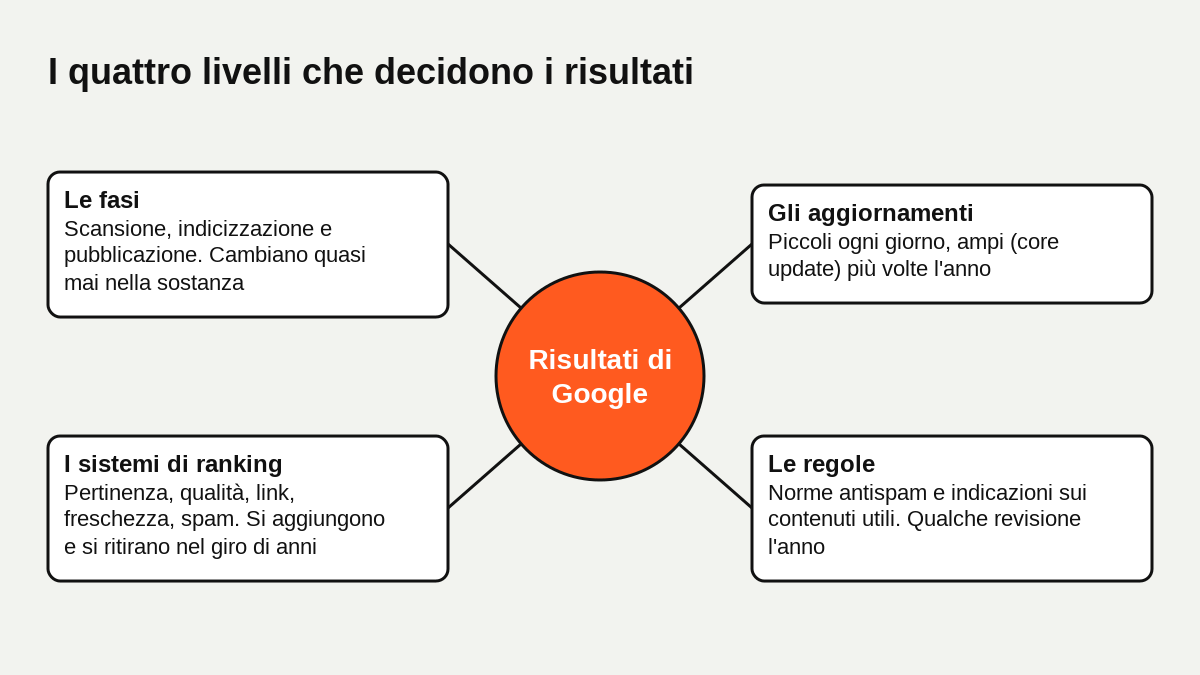
Keeping them separate avoids the most common mistake: blaming a “new algorithm” for a drop that actually comes from a page falling out of the index, or hunting for a technical problem when a core update just rolled out.
Two points apply to every layer. First, ranking is programmatic, and Google does not accept payment to crawl a site more often or to rank it higher. Ads are a separate product, labeled “Sponsored”. Second, relevance is determined by hundreds of factors, and Google does not publish a list with their weights. What it does publish are the systems, the rules and the dates of updates, and that is the place to start.
The three stages: crawling, indexing, serving results
Every page goes through three stages, always in the same order. Google's in-depth guide to how Search works describes them one by one, including the reasons a page can stall at each.
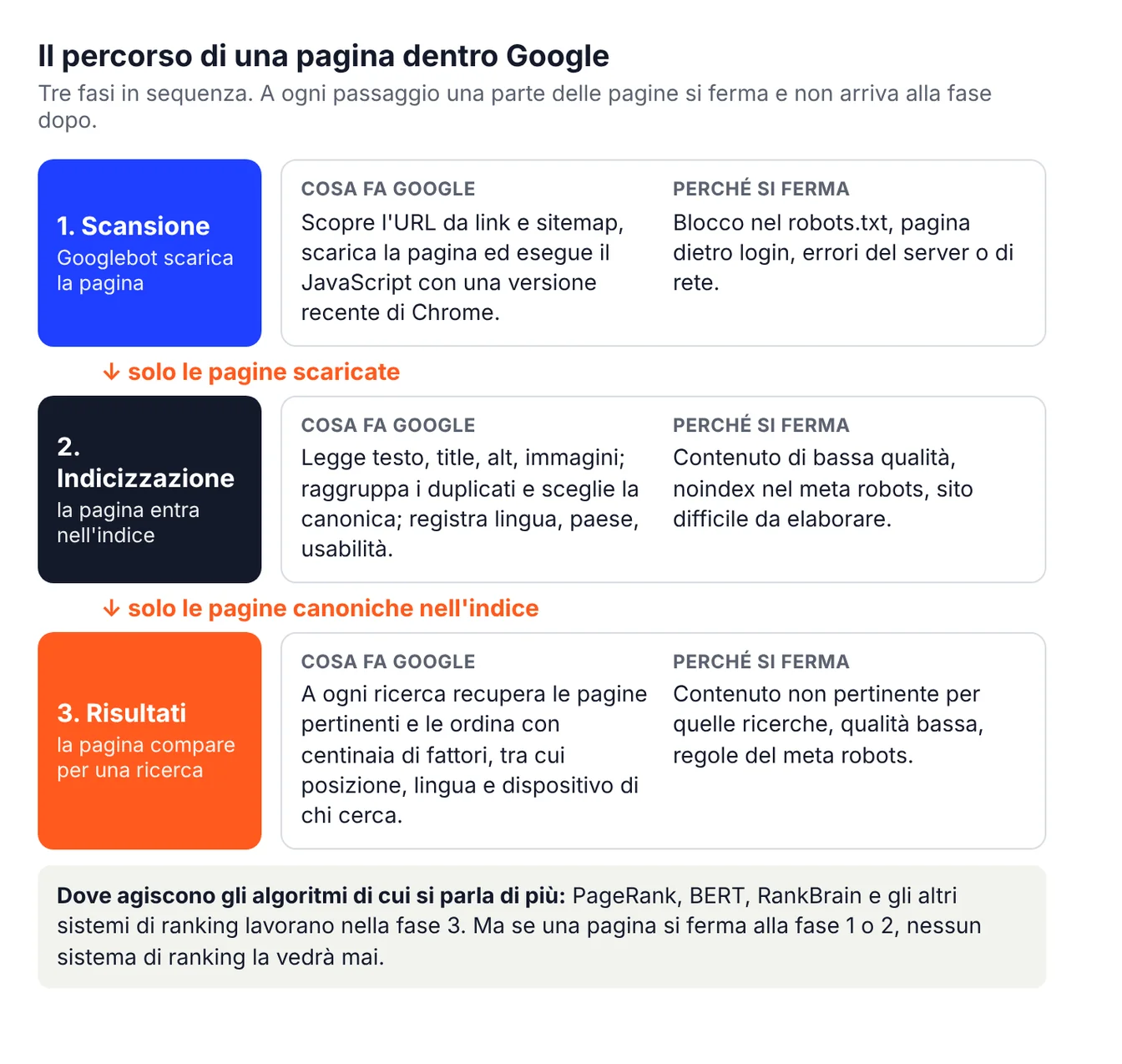
Crawling: Google discovers and downloads the page
There is no central registry of web pages. Google discovers them by following links from pages it already knows, reading sitemaps and revisiting URLs it has seen before.
The crawler, Googlebot, uses an algorithmic process to decide which sites to visit, how often and how many pages to fetch. It slows down if the server responds with errors: to Google, a 500 error means “go slower”. During crawling it also runs JavaScript with a recent version of Chrome, because many sites show content only after scripts run.
A page is not crawled if robots.txt blocks it, if it requires a login or if the server does not respond.
Indexing: Google works out what is on the page
Once the page is downloaded, Google analyzes its text, title, alt attributes, images and videos. Then it groups pages with very similar content and picks a canonical version for each group: that is the only one that can appear in results.
For the canonical page it records signals such as language, the country it targets and usability. Everything goes into the index, a huge database. Indexing is not guaranteed: a low-quality page, one with a noindex or one on a site that is hard to process can stay out.
Serving results: Google picks and orders
For every search, Google retrieves relevant pages from the index and ranks them. Factors include the searcher's location, language and device: the same search made in Milan or Bologna, on a phone or a computer, can return different results.
This is the stage where the ranking systems covered in the next chapter work. A page can show as indexed in Search Console and never appear, because it is not relevant for the searches that matter or because other pages answer better.
An example across the three stages
A hypothetical case: a bike shop in Bologna publishes the page “E-bike repair in Bologna”.
- Crawling. The page is linked from the menu and appears in the sitemap: Googlebot finds it. If it were reachable only from a booking form, Google might never find it.
- Indexing. The text is original: brands serviced, average turnaround times, indicative diagnosis prices. If it were identical to the pages “E-bike repair in Modena” and “in Ferrara”, with only the city changed, Google would keep one as canonical and leave out the others.
- Results. For “electric bike repair Bologna” the page competes with workshops, brand service centers and Maps listings. The winner is whoever answers best the person searching at that moment, from that place.
Typical mistake. Working on the ranking of a page that is not in the index. Before rewriting a text, the URL Inspection tool in Search Console tells you which stage the page stopped at.
The ranking systems Google documents: active and retired
Google maintains a ranking systems guide that lists the systems in use and the retired ones. It is the most useful document for answering “what are Google's algorithms?”, because Google itself makes the list. As of the latest update, in December 2025, there are 17 active systems and 4 retired ones.
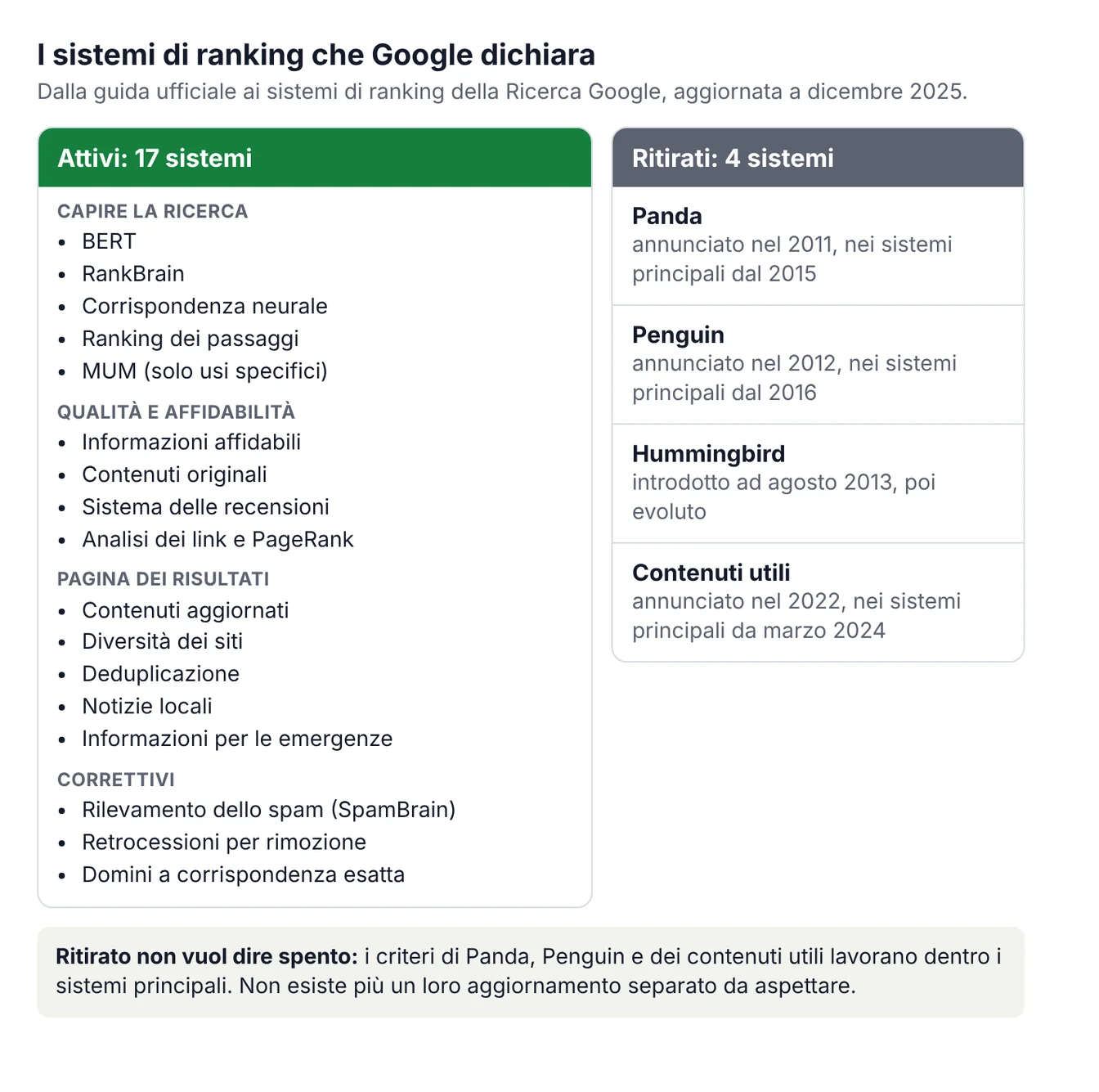
The groups in the figure are mine, to make them easier to read: the guide lists the systems in alphabetical order.
Understanding the search and the page
Five systems help understand what the searcher is asking and what a page says, beyond the exact words:
- BERT understands how combinations of words express different meanings and intents;
- RankBrain links words to related concepts, even when the page does not use the search terms;
- neural matching associates the concepts in a query with those in pages;
- passage ranking evaluates individual sections of a page, not just the whole page;
- MUM understands and generates language, but today it is not used for general ranking: only for specific applications.
Quality, reliability and links
The reliable information system surfaces more authoritative pages and demotes low-quality content; when reliable sources are missing, it can show a notice. The original content system gives visibility to those who produced a piece of information over those who merely repeat it. The reviews system rewards reviews written by people who really know the product.
Then there is link analysis and PageRank: links between pages are still used to understand what a page is about and how useful it is. The public score disappeared years ago, the system did not.
How the results page is built
Other systems do not judge the single page but the composition of the SERP. The fresh content systems favor recent information when the search calls for it. Site diversity generally avoids showing more than two results from the same site in the top results. Deduplication removes near-identical pages. Local news and crisis information kick in for particular searches, from city news to emergency situations.
The corrective systems
Three systems push down results that would otherwise rank too high. Spam detection, which includes SpamBrain, identifies practices banned by the spam policies. Removal-based demotions hit sites with many valid removal requests, for example for copyright infringement. The exact match domain system avoids giving too much credit to a domain just because it repeats the search, like a hypothetical “ebike-repair-bologna.com”.
The retired systems
Panda, Penguin, Hummingbird and the helpful content system no longer exist as separate systems. Retired, however, does not mean switched off: Panda joined the core systems in 2015, Penguin in 2016, helpful content in March 2024. Hummingbird, introduced in August 2013, evolved into the systems that followed.
The practical consequence is that there is no point waiting for “the next Panda” or “the next Helpful Content Update”. Their criteria work inside the core updates.
Typical mistake. Trying to “optimize for BERT” or “for RankBrain”. There is nothing to tune for a single system: they are tools Google uses to understand naturally written text. The chapter on Google BERT uses Google's own examples to show where it got things wrong before and what it means, in practice, to write for an engine that reads context.
From PageRank to AI answers: what each algorithm solved
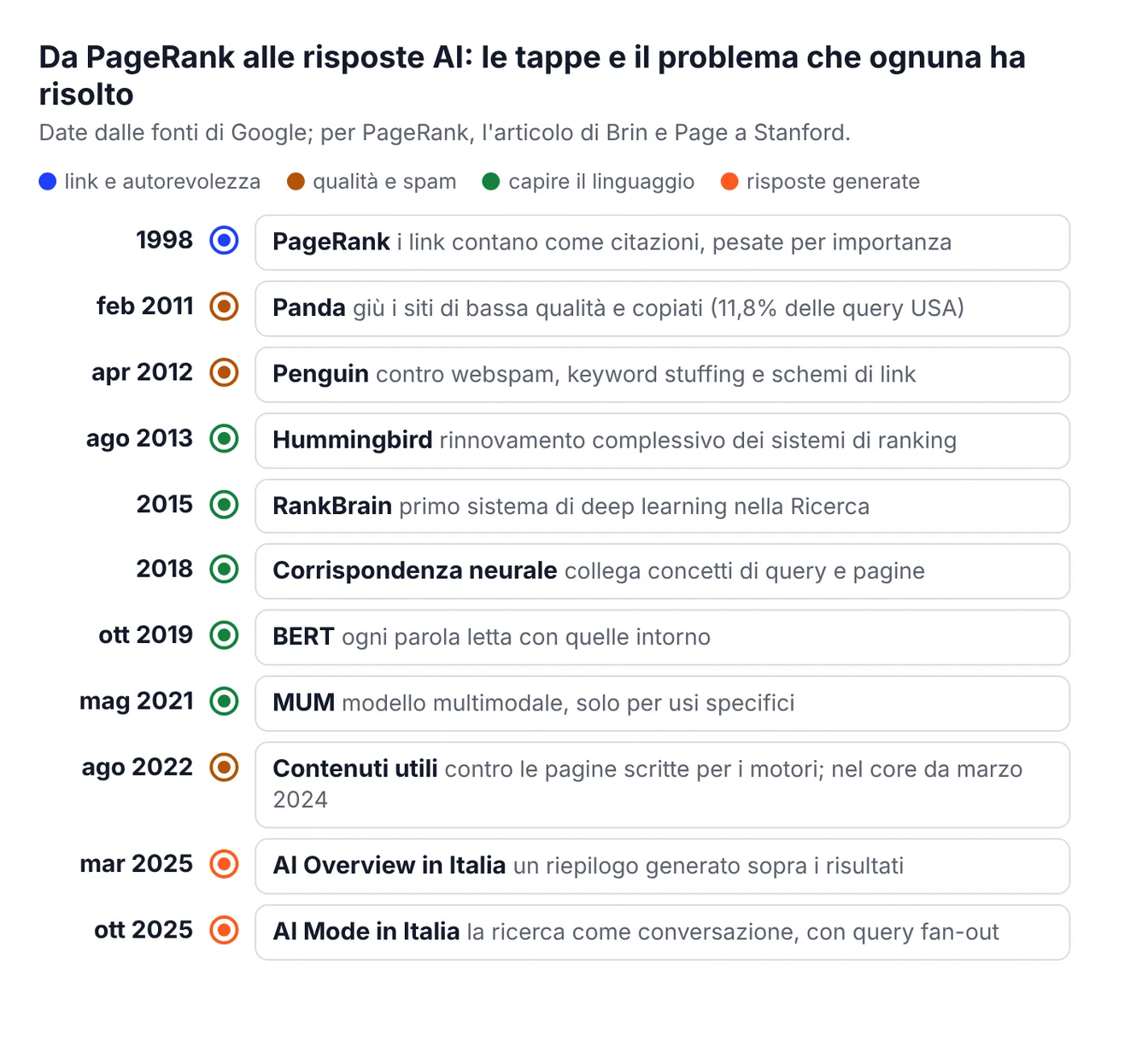
The history of Google's algorithms is a series of problems and answers. Every time a shortcut worked too well, Google built a system to neutralize it, or to better understand what searchers want. Here is the map; each stage has its own chapter.
1998, PageRank: links as citations
The search engines of the late 1990s trusted signals the site controlled itself, such as keyword repetition. In 1998 Sergey Brin and Larry Page, at Stanford, described PageRank: a page counts for more if it receives links from other important pages, and not all links are worth the same. It is the idea Google was built on.
The formula, a worked calculation and the use of internal links are in the chapter on Google PageRank.
2011, Panda: against thin content
On February 24, 2011 Google announced a change that lowers low-quality sites, with little value or copied content, and rewards those with original research, analysis and information. In the United States it visibly affected 11.8% of queries.
The problem Panda targeted is still current: the chapter on Google Panda explains how to recognize weak content on a site and how to fix it.
2012, Penguin: against webspam and artificial links
On April 24, 2012 came the update later called Penguin, aimed at webspam: repeated keywords, link schemes, text scrambled until unrecognizable. In English it affected about 3.1% of queries. Since 2016 it has been part of the core systems.
How to recognize an artificial link profile and how to recover are in the chapter on Google Penguin.
2013, Hummingbird: the meaning of the search
Hummingbird, introduced in August 2013, was an overhaul of the ranking systems as a whole, more than an update aimed at a single problem. The chapter on Google Hummingbird explains why it was a new engine and not a tweak.
2015-2021: RankBrain, BERT and language models
In 2015 RankBrain became the first deep learning system used in Search: it links words to concepts. In 2018 neural matching arrived. On October 25, 2019 Google introduced BERT, which understands the weight of each word in the context of a sentence, even a preposition; at launch it affected about one in ten English searches in the United States. In May 2021 came MUM, multimodal and trained on 75 languages, which however remains confined to specific uses.
What RankBrain does, what it does not do and what is wrongly said about clicks is in the chapter on RankBrain.
2022-2024: helpful content
On August 25, 2022 the helpful content update launched, against pages written for search engines instead of people. After further releases in December 2022 and September 2023, in March 2024 the system joined the core systems, along with three new spam policies: scaled content abuse, expired domain abuse and site reputation abuse.
2025-2026: generated answers and Discover
On March 26, 2025 AI Overviews arrived in Italy, and on October 8, 2025 AI Mode. I cover them in the chapter on AI answers, further down. In February 2026 Google also released an update dedicated only to Discover, the feed of recommended content on your phone: how it works, how to appear in it and how to turn it off is in the chapter on Google Discover.
The full timeline, from 2000 to this year's releases, is in the chapter on Google updates from 2000 to today.
Core updates and spam updates: how to recognize them
When people search for “new Google algorithm”, they are almost always talking about an update, not a new system. Google changes its systems constantly: small tweaks are not announced because they are barely visible. Broad ones get a name and a date.
Core updates: the ranking shifts, no one is “punished”
Several times a year Google releases a core update, a broad and significant change to its core systems. It does not target specific sites or pages. Google explains it with an example: a list of your favorite restaurants changes over time even if no restaurant got worse, because you discover new ones or change your criteria.
That is why a site can drop without having done anything wrong: other pages were assessed as better. According to Google, most sites do not need to worry and often do not even notice.
Spam updates: SpamBrain gets better
The anti-spam systems work all the time. Now and then Google improves them significantly, especially SpamBrain, its AI-based spam prevention system, and announces a spam update. A site that violates the spam policies can lose rankings or disappear from results.
Recovery, if it comes, takes months: the systems need to see over time that the site complies with the policies. Link spam updates carry an extra limit: when Google neutralizes the effect of those links, the benefit they gave cannot be recovered.
Google's automated systems, the company writes, find 40 billion spam pages every day. The rest is handled by a team that can apply a manual action, visible only to the site owner in the Manual actions report in Search Console.
The latest updates, with official dates
Since 2021 Google has logged ranking updates on the Search Status Dashboard, with start date and duration. These are the ones from 2025 to today:
| Update | Start | Rollout duration |
|---|---|---|
| November 2026 core update | November 10, 2026 | ongoing; Google expects up to 2 weeks |
| September 2026 spam update | September 24, 2026 | 13 days, 16 hours |
| August 2026 spam update | August 18, 2026 | 2 days, 16 hours |
| June 2026 spam update | June 24, 2026 | 2 days, 1 hour |
| May 2026 core update | May 21, 2026 | 11 days, 21 hours |
| March 2026 core update | March 27, 2026 | 12 days, 4 hours |
| March 2026 spam update | March 24, 2026 | 19 hours, 30 minutes |
| February 2026 Discover update | February 5, 2026 | 21 days, 17 hours |
| December 2025 core update | December 11, 2025 | 18 days, 2 hours |
| August 2025 spam update | August 26, 2025 | 26 days, 15 hours |
| June 2025 core update | June 30, 2025 | 16 days, 18 hours |
| March 2025 core update | March 13, 2025 | 13 days, 21 hours |
The November 2026 core update started on November 10 and applies to all countries and all languages. Until the rollout is complete, the positions you see in Search Console are provisional.
The names in the table are the official ones, with month and year. If you read about a “new algorithm” with a made-up name, check the dashboard: almost always it is a label given by third parties to one of these releases.
What to do when an update arrives
Google has a page on core updates with guidance for anyone who sees a drop. I follow it in this order, adding an initial check: ruling out that the drop has another cause.
- Check that it really is the update. A drop can come from a technical problem, a manual action, seasonality or a change in the SERP. The chapter on updates has a table to tell them apart case by case.
- Wait for the rollout to end. Note the start and end from the dashboard. During the rollout positions swing: measuring after three days means measuring noise.
- Compare the right weeks. Google recommends waiting at least one full week after the end and comparing it, in Search Console, with a week before the start.
- Measure how much you lost. A page that moved from second to fourth position does not call for drastic action. A move from fourth to twenty-ninth, on the other hand, calls for a serious assessment.
- Separate the search types. Web, Images, Video and News are looked at one by one: a drop only in images tells a different story.
- Assess the affected pages as a stranger would. Google's self-assessment questions on helpful content are the tool: original information, firsthand experience, sources, a clear author. Google also suggests asking for an honest opinion from people you trust who do not work on the site.
- Actually improve. Rewrite, restructure, merge. Deleting content is the last resort.
- Give it time. Some effects show in a few days, others take months, because the systems need to confirm the improvement over time. Sometimes the next core update is needed, and Google does not guarantee that the changes will be enough.
In my work, the first check after a core update is the comparison between lost pages and queries. If the drop is spread across the whole site, the problem is usually general (average quality, purpose of the site). If it is concentrated on a few pages, almost always other pages answer those searches better, and all you need to do is open the SERP to see which ones.
Typical mistakes. Removing page elements because they “hurt SEO”, without evidence. Changing only the publication date to look updated: Google lists exactly that among the things not to do. Adding or removing text in bulk to “signal freshness”: rankings do not improve.
Quality raters: what they do and what they don't
Few topics are as misunderstood as this one. Google works with external evaluators, the quality raters, who judge samples of results following public guidelines. They do not decide any site's ranking.
How they work
Raters take part in two kinds of tests. In quality tests they assess how well a page answers a search and how trustworthy it is. In side-by-side experiments they see two lists of results, one with a change and one without, and say which they prefer and why.
Alongside them are live traffic experiments: the change is switched on for a small share of users, starting from 0.1%, and compared with a control group. In 2023, according to Google, the numbers were these:
| Type of test (2023) | How many |
|---|---|
| Search quality tests | 719,326 |
| Side-by-side experiments | 124,942 |
| Live traffic experiments | 16,871 |
| Launches | 4,781 |
The ratio says a lot: hundreds of thousands of evaluations for a few thousand launched changes in a year, that is more than ten a day.
What the guidelines contain
The Search Quality Rater Guidelines, in the September 11, 2025 version, are a document of about 180 pages. They have two main scales:
- Page Quality, from Lowest to Highest: how well the page achieves its purpose. The worst pages are untrustworthy, deceptive or harmful;
- Needs Met, from Fails to Meet to Fully Meets: how well the result satisfies the person who ran that search.
For YMYL (Your Money or Your Life) topics, those that can affect health, money, safety or the well-being of society, the required standard is higher.
What they don't do
The guidelines say it explicitly: no single rating can directly change how a page or site appears in Search. Rater data does not feed directly into the algorithms; it serves to measure whether the systems work and to decide which changes to launch.
The rater guidelines are also a different document from Search Essentials, which contain the technical requirements and spam policies for site owners. The former describe what Google considers a good result; the latter, what a site must do to be eligible.
Typical mistake. Treating the guidelines as a list of ranking factors (“raters look at the About page, so the About page boosts rankings”). They are useful for understanding direction, not for ticking boxes.
E-E-A-T and helpful content: what the systems really reward
E-E-A-T is the acronym used in the rater guidelines for Experience, Expertise, Authoritativeness and Trust: firsthand experience, competence, authority and reliability. Trust is at the center: of the four aspects it is the most important, according to both the guidelines and Google's guide to helpful content.
It is not a ranking factor, but it describes what the systems look for
Google is clear: E-E-A-T is not a specific ranking factor. The automated systems use many factors to identify content that shows experience, expertise, authoritativeness and trustworthiness, and they give these aspects more weight for YMYL topics.
In practice there is no “E-E-A-T score” to raise. There are pages that show readers who wrote them, with what experience and why they can be trusted.
Who, how and why
The helpful content guide proposes three questions to ask about every page:
- Who created it? An author with a name and a page presenting them. Invented authors or fake credentials make the page untrustworthy;
- How was it made? In a review, for example, how many products were tested and with what method;
- Why does it exist? This is the most important question: the purpose must be to help readers, not to attract traffic from search engines.
A hypothetical example: two pages on the same topic, “how to choose a condensing boiler”. The first is signed by a heating engineer from Milan, explains which models he installs and why, and shows a table of consumption measured in two homes. The second summarizes what is already on the first pages of Google, with no author. On the same topic, the first answers all three questions; the second none.
AI-generated content
Google does not ban automation: what matters is how and why you use it. A text prepared with the help of AI, then checked, completed and signed by someone who knows the subject, can be good content. Generating many pages without human review, only to rank, falls under scaled content abuse, a practice banned by the spam policies regardless of the tool used.
The guide's self-assessment questions are also the basis of the downloadable checklist on this page: I use them as a first filter after every core update.
AI Overviews and AI Mode: what they change for clicks
Since 2025, for many searches, Google no longer answers with just a list of links. AI Overviews show a generated summary above the results, when Google thinks they add value. AI Mode is a conversational search mode, designed for complex questions and comparisons.
How they build the answer
Both use query fan-out: they break the question into subtopics and run many searches in parallel, to find more pages supporting the answer. The sources come from the same index and the same ranking and quality systems as Search.
For this reason, according to Google, there are no additional requirements to appear as a link in an AI answer. The page must be indexed and eligible to show a snippet. Files like llms.txt, dedicated markup or text chopped into small blocks are not needed: Google writes that Search does not use them, and that optimizing for generative AI features is still SEO.
Same position, fewer clicks
What changes is how much people click. In a Pew Research Center study of 900 US adults, in March 2025, people who saw an AI summary clicked a traditional result in 8% of visits, against 15% of those who did not see one. Links inside the summary were clicked in 1% of cases.
I asked the same question of the data from the sites I follow. I took the same queries, on the same sites, at the same average position, a year apart: 4,453 query pairs between July-September 2025 and July-September 2026, across the 7 sites with data in both periods.
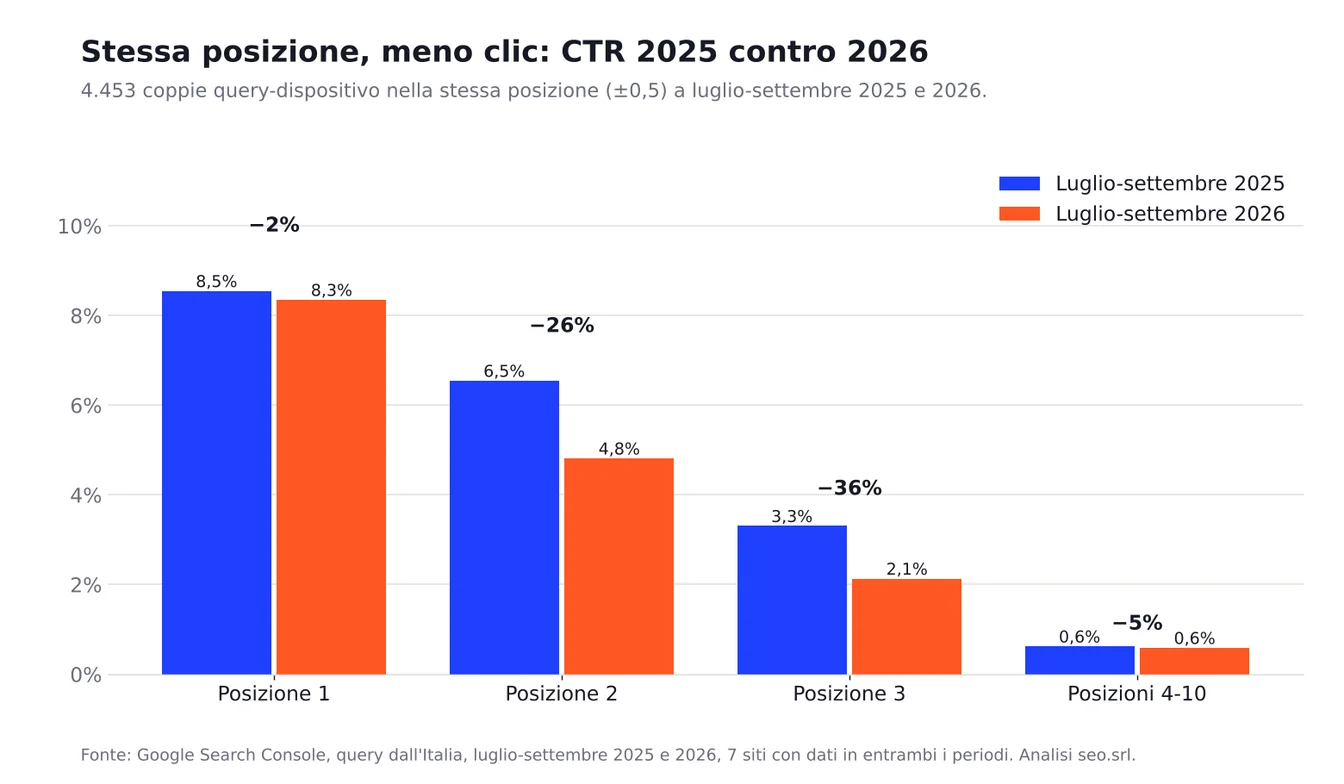
Google Search Console data from 22 Italian sites I follow, searches from Italy, July-September 2026 (14 million impressions) and, for comparison, July-September 2025. Aggregated, anonymous data.
CTR across the top ten positions fell by 14%. Whoever ranked first held up (8.5% versus 8.3%). Whoever ranked second lost 26% of clicks, third lost 36%. The position stayed the same: what is above it changed.
The drop does not depend on a single site: 6 sites out of 7 declined, and removing the largest one the drop stays at 15%.
What it means for how you read your data
Traffic coming from AI features is included in the Search Console performance report, under the “Web” search type, together with everything else. A drop in clicks with stable impressions and positions, after 2025, is not necessarily a problem with the site: it can be the results page that has changed.
Anyone who wants to opt out of AI answers has the same controls as for snippets: nosnippet, data-nosnippet, max-snippet, noindex. These controls apply to the whole of Search, so they also limit the snippet in classic results.
Official sources, patents and leaked documents: telling facts from hypotheses
Plenty of certainties and little proof circulate about how Google works. Before changing anything on a site because of something I read online, I check where the information comes from. Sources do not all carry the same weight.
| Source | What it tells you | What it doesn't tell you |
|---|---|---|
| Search Central documentation | Active systems, rules, requirements, what to do after an update | The weight of individual signals |
| Search Status Dashboard | Dates and duration of updates | What changed in detail |
| Quality rater guidelines | What Google considers a good result | How that translates into ranking |
| Patents | Methods Google wanted to protect | Whether and how it uses them today |
| Documents leaked in 2024 | Names of attributes and modules in internal documentation | Which ones are used in ranking, with what weight, whether they are still active |
| Third-party tests and studies | Correlations observed on a sample | The causes |
The documents leaked in 2024
On May 27, 2024 Rand Fishkin, of SparkToro, published the first analysis of internal documentation of Google Search's APIs: over 2,500 pages with 14,014 attributes, in his count. The same article warns that those documents, on their own, do not prove which elements are used in ranking.
That is the limit of any API documentation: it lists data the systems can store, not how much it weighs or whether it is still in use. Many readings published afterwards presented it as “the recipe of the algorithm”, and it is not.
What is in the documents, which denials hold up and which do not, and what changes in practice, is in the chapter on the Google Leak. Patents, read by keeping the text, interpretations and Google's statements separate, have a guide of their own: Google patents and SEO.
Typical mistake. Taking an attribute found in a document, or a claim in a patent, and turning it into a “ranking factor” to optimize. Before acting, ask yourself whether the same thing also makes sense for the people reading the page: if yes, do it anyway; if not, skip it.
What follows for anyone with a website
From the map of the systems you get a work order. Each item corresponds to a layer of this guide, and should be tackled in sequence: there is no point working on the quality of pages Google does not index.
| What you do | Which system or stage it affects | Where you check |
|---|---|---|
| Make important pages reachable, with internal links and a sitemap | Crawling | Crawl stats in Search Console |
| One page per search, no copies with only the city changed | Indexing, deduplication | Pages report, URL Inspection |
| Natural text that answers the full question | BERT, RankBrain, passage ranking | Queries bringing impressions to each page |
| Your own information: data, evidence, examples, experience | Original content, reliable information, reviews | Comparison with the pages ranking above you |
| Recognizable author, who runs the site, how to contact them | Trust, the most important part of E-E-A-T | Author page, About page |
| Earned links, no bought or swapped links | Link analysis and PageRank, SpamBrain | Links report in Search Console |
| Real updates when facts change, not just the date | Fresh content | Modified date and actual content |
| Google update dates noted next to your own data | Core updates and spam updates | Search Status Dashboard |
No item in the table depends on a single algorithm. That is why, in more than fifteen years of work, I stopped asking what the next update wants: the systems change, the target has always been the same, the page that best answers the person searching.
If a drop survives all these checks and a manual action shows up in Search Console, the work becomes something else: how to request a review is covered on the page about Google penalties.
Frequently asked questions
How many ranking factors does Google use?
Google says it uses hundreds of factors, but it does not publish a list with their weights. What it does publish are the systems that combine them, such as link analysis, language understanding, original content, reviews and spam detection. The lists of “200 factors” with scores that circulate online are third-party reconstructions, not official data.
How often does Google update its algorithms?
Constantly: small changes happen daily and are not announced. Broad ones, the core updates, come a few times a year: three in 2025 and three so far in 2026 according to the Search Status Dashboard, plus spam updates and targeted updates like the Discover one in February 2026.


