
Google BERT: What It Is, How It Works and What Matters Today for SEO
Google BERT is the AI model that has helped Search understand the meaning of queries since 2019: how it works, its link to MUM, AI Overviews and AI Mode, and how to write today.

Eugenio Tommasi
Founder of SEO SRL
Published 8 min read

Google BERT is an AI language-understanding model, used in Search since 2019, that reads each word of a query together with the words before and after it to understand the meaning of the search.
Table of contents (9 sections)
- BERT at a glance
- What the BERT acronym means
- How it works: every word read with the words around it
- Google's examples: where it went wrong before
- BERT and the other systems: RankBrain, neural matching, passage ranking
- BERT today: DeepRank, MUM, AI Overviews and AI Mode
- Can you optimize for BERT?
- How to write for a Google that reads context
- Frequently asked questions
Google BERT is an AI language-understanding model that Google has used in Search since 2019. It reads each word in a query together with the words before and after it, so it grasps the meaning of the question and not just the keywords. In Italian it has been live since December 9, 2019.
It is not a penalty, you can't "optimize" for it, and it hasn't been replaced by generative AI: Google still lists it among its active ranking systems.
BERT at a glance
| Question | Answer |
|---|---|
| Full name | Bidirectional Encoder Representations from Transformers |
| Who created it | Google AI Language (Jacob Devlin, Ming-Wei Chang, Kenton Lee, Kristina Toutanova) |
| Published and open sourced | Research paper on October 11, 2018, open-source code on November 2, 2018 |
| Used in Search | Since October 25, 2019, at first on about one in ten English-language searches in the United States |
| In Italian | Since December 9, 2019, along with more than 70 languages |
| What it does | Understands how combinations of words express different meanings and intents |
| Where it works | Ranking, document retrieval and featured snippets |
| Status today | Active system in Google's ranking systems guide |
What the BERT acronym means
Each word in the name says something about how it works:
- Bidirectional: it reads the context to the left and to the right of each word at the same time, not just left to right.
- Encoder: it turns text into a numerical representation the system can compare. It doesn't generate text: it understands it.
- Representations: the output is a representation of each word that changes depending on the sentence it appears in.
- Transformers: the neural network architecture it is built on, the same one today's language models derive from.
In the original paper, BERT beat the state of the art on eleven natural language processing (NLP) tasks. On SQuAD v1.1, a question-answering test, its F1 score was 93.2, above the previous best leaderboard result (91.7) and above the human result (91.2).
How it works: every word read with the words around it
Earlier models gave a word the same meaning every time, or read it by looking only at the words that come before it. Google's example is the sentence “I accessed the bank account”: a model that reads only from the left interprets “bank” using “I accessed the”, while BERT also uses “account”, which comes after, and understands it's about a financial institution and not a riverbank.
To learn this, BERT was trained on large amounts of text with two exercises:
- Hidden words (masked language model): some words in the sentence are covered and the model has to guess them using the words on both sides.
- Next sentence (next sentence prediction): the model sees two sentences and has to work out whether the second really follows the first or was picked at random.
The result is a system that also gives weight to small words, like prepositions and negations, which search engines used to tend to overlook.
Google's examples: where it went wrong before
The October 25, 2019 announcement by Pandu Nayak, Vice President of Search, contains five English queries with before and after results. I've summarized them in a table: they show well the kind of mistake BERT fixes.
| Query | Decisive word | Error before BERT |
|---|---|---|
| 2019 brazil traveler to usa need a visa | “to” | Results for US citizens traveling to Brazil, i.e. the trip in reverse |
| do estheticians stand a lot at work | “stand” | Matched “stand” with “stand-alone”, not with standing on your feet |
| can you get medicine for someone pharmacy | “for someone” | Generic results about prescriptions, not about picking up medicine for another person |
| parking on a hill with no curb | “no” | Ignored the negation and showed how to park uphill with a curb |
| math practice books for adults | “for adults” | Suggested a book for young people |
Google also admitted a limit: for the query “what state is south of Nebraska” BERT's best answer was still a place called South Nebraska. Understanding language remains an open problem, and they are the first to say so.
Prepositions carry as much weight in Italian as they do in English. Take the searches “flights from Rome to Paris” and “flights from Paris to Rome” (in Italian, “voli da Roma a Parigi” and “voli da Parigi a Roma”). The words are the same, the intent is the opposite. A system that looks only at keywords treats them almost the same way; a system that reads context has the tools to tell them apart. For writers, this means a page must answer the exact question, not a set of words.
BERT and the other systems: RankBrain, neural matching, passage ranking
BERT doesn't work alone. Google's AI systems work together, each with its own job. In 2022 BERT was involved in almost every English-language search, both in ranking and in document retrieval.
| System | Year | What it does |
|---|---|---|
| RankBrain | 2015 | Links words to concepts, so a relevant page can rank even without the exact words of the search |
| Neural matching | 2018 | Matches the concepts in queries with those in pages; mainly used to retrieve potentially relevant documents |
| BERT | 2019 | Understands how combinations of words express meanings and intents |
| Passage ranking | 2021 | Evaluates individual sections of a page, not just the whole page (live in English in the United States since February 10, 2021) |
| MUM | 2021 | Understands and generates language; not used for general ranking |
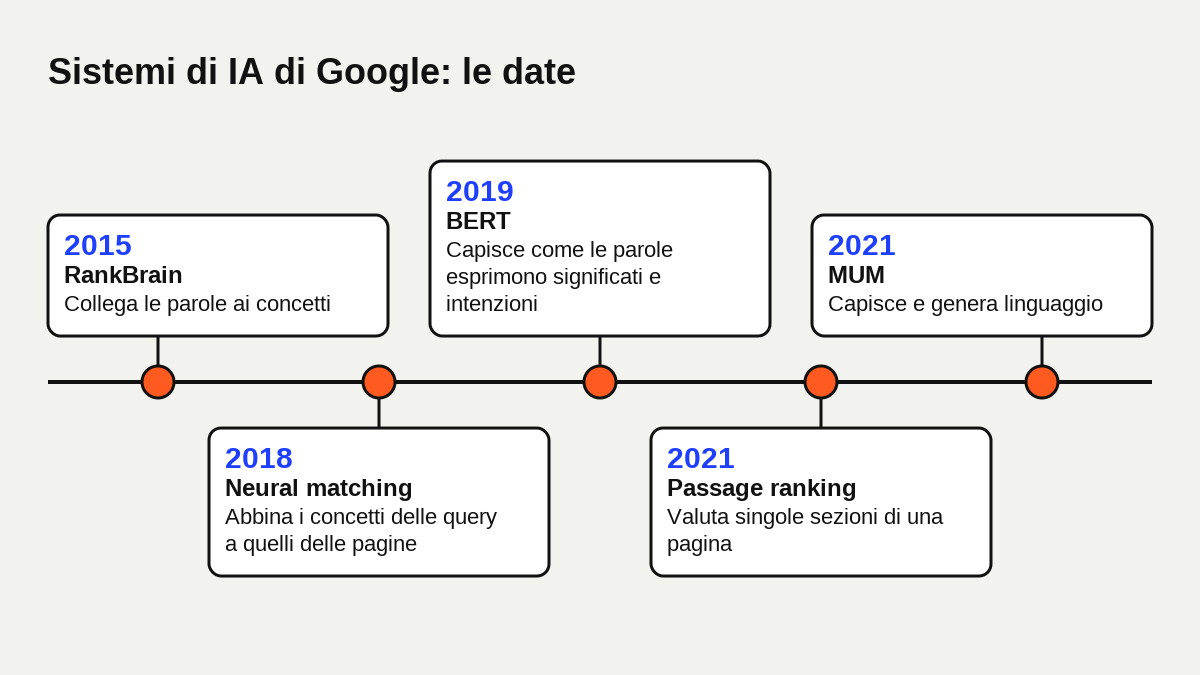
Before all of these came Hummingbird, in 2013: the first big step from keywords to the meaning of the query, now among the retired systems.
BERT today: DeepRank, MUM, AI Overviews and AI Mode
With generative AI arriving in Search, it's fair to ask: is BERT still needed? Yes, and here are the facts.
- It's still active. Google's ranking systems guide, updated in December 2025, lists it among the systems in use.
- Inside Google it's also called DeepRank. In his testimony at the US antitrust trial (October 2023), Pandu Nayak explained that DeepRank is BERT when it is used for ranking, and that it is absorbing some of RankBrain's capabilities.
- MUM didn't replace it. MUM, introduced on May 18, 2021 as “1,000 times more powerful than BERT”, is trained on 75 languages and is multimodal. It isn't used for general ranking, though, but for specific applications, such as COVID-19 vaccine searches and featured snippets. Nayak described it as too big and slow to run on every query.
- AI Overviews and AI Mode rest on the same systems. Both use a custom Gemini model working alongside Search's ranking and quality systems. AI Mode uses query fan-out: it splits the question into subtopics and launches many related searches, then combines the results.
The practical link is this: if the generated answer pulls its sources from the index using the ranking systems, a page that the language-understanding systems judge relevant has more chances of being retrieved in the fan-out sub-searches too. You'll find the details in the guides on AI Overviews and AI Mode.
Can you optimize for BERT?

No. Danny Sullivan, Google's Search Liaison, said so as early as October 28, 2019: there's nothing to optimize for with BERT, and nothing to rethink. The model is public, but the way Google uses it in ranking is not.
I've been doing SEO since 2009, and BERT is one of the few changes where the right move was not to chase it. It's different from Penguin, which targeted artificial links, and from Panda, which targeted thin content. BERT doesn't punish anyone: it just stops rewarding, by accident, pages that contained the right words without answering the question.
How to write for a Google that reads context
This is the checklist I use when I rewrite a piece of content:
- Start from the real question. Look at how people type the search, prepositions included: “for”, “from”, “without”, “to”. Solid keyword research gives you phrases, not just words.
- Answer in the first two lines. A definition or direct answer, then the details. It's also what lends itself to ending up in a featured snippet or being cited in an AI answer.
- One section, one question. Clear H2 and H3 headings, each on one subtopic. Passage ranking evaluates sections and fan-out looks for sub-questions: a section that answers a sub-question well has more chances.
- Remove forced repetition. If a sentence sounds odd because the keyword is crammed in, rewrite it. Natural synonyms and variants are fine.
- Don't cut negations and conditions. “Without”, “only if”, “except”: these are the words BERT reads, and they make the difference between a right answer and a wrong one.
- Include verifiable facts. Numbers, dates, linked sources. Understanding language isn't enough for Google to trust a page: it needs reliable content.
For me, the starting point is still the audience: know your target and you already know which questions they'll ask.
Want copy that answers real searches instead of chasing keywords? Take a look at the SEO copywriting service, or find out what's holding your site back on Google and in AI with the SEO audit: you get the 5 things to fix first on your main pages.
To see how BERT fits into the rest of how Search works, read the guide on how Google works.
Frequently asked questions
Does Google still use BERT?
Yes. Google's ranking systems guide, updated in December 2025, lists it among the active systems. In his testimony at the US antitrust trial in October 2023, Pandu Nayak explained that DeepRank is BERT when it is used for ranking.
What is the difference between BERT and MUM?
MUM, introduced on May 18, 2021, is a larger model: 1,000 times more powerful than BERT, trained on 75 languages and able to understand text and images. It isn't used for general ranking, though, only for specific applications such as COVID-19 vaccine searches and featured snippets. In 2022, BERT, by contrast, was involved in almost every English-language search.
Can you optimize a site for BERT?
No, not specifically. Danny Sullivan, Google's Search Liaison, said so on October 28, 2019: there's nothing to optimize for with BERT. In practice, it pays to answer the exact question in the first lines, organize the page into clear sections, write naturally and not build your copy around repeating keywords.


