
Google PageRank: What It Is, How It's Calculated and How Much It Matters Today
PageRank is the algorithm Google uses to estimate a page's importance from the links it receives: the formula with a step-by-step worked example, the code to redo it, what has changed since 1998 and how much links matter today.

Eugenio Tommasi
Founder of SEO SRL
Published 10 min read

PageRank is Google's algorithm, devised by Larry Page and Sergey Brin in 1998, that assigns every web page an importance score based on the quantity and quality of the links it receives.
Table of contents (10 sections)
- PageRank at a glance
- Where it comes from: the random surfer
- The formula
- An example with three pages
- Calculating it in a few lines of code
- How it has changed from 1998 to today
- PageRank today
- Internal links: how to distribute value across your site
- External links: what to do and what to avoid
- Frequently asked questions
PageRank is the algorithm Google uses to estimate how important a page is based on the links it receives. What counts is how many links there are and which pages they come from, because a link from an important page is worth more than one from a page nobody links to. Larry Page and Sergey Brin described it in 1998, and Google still uses it as one of its core ranking systems.
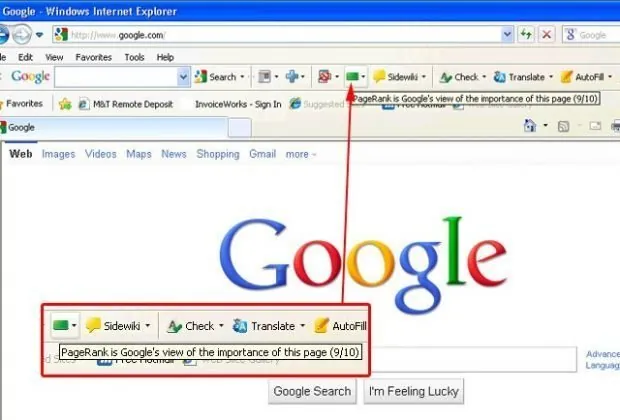
The public 0-to-10 score has not existed since 2016, but the principle still works.
PageRank at a glance
| Question | Answer |
|---|---|
| What it is | An importance score calculated from the links between pages |
| Who invented it | Larry Page and Sergey Brin, at Stanford University |
| When | Described in 1998 in the paper "The Anatomy of a Large-Scale Hypertextual Web Search Engine" |
| What it measures | The importance of the page, not its relevance to the search |
| Public score | Discontinued: Google confirmed its removal from the toolbar in March 2016 |
| Status today | One of Google's core ranking systems, much evolved from the original |
Where it comes from: the random surfer
In the late 1990s, search engines ranked results mostly by looking at the text of pages, and they were easy to fool by repeating words. Page and Brin added an idea borrowed from academic citations: a page linked to by many important pages is probably important itself.
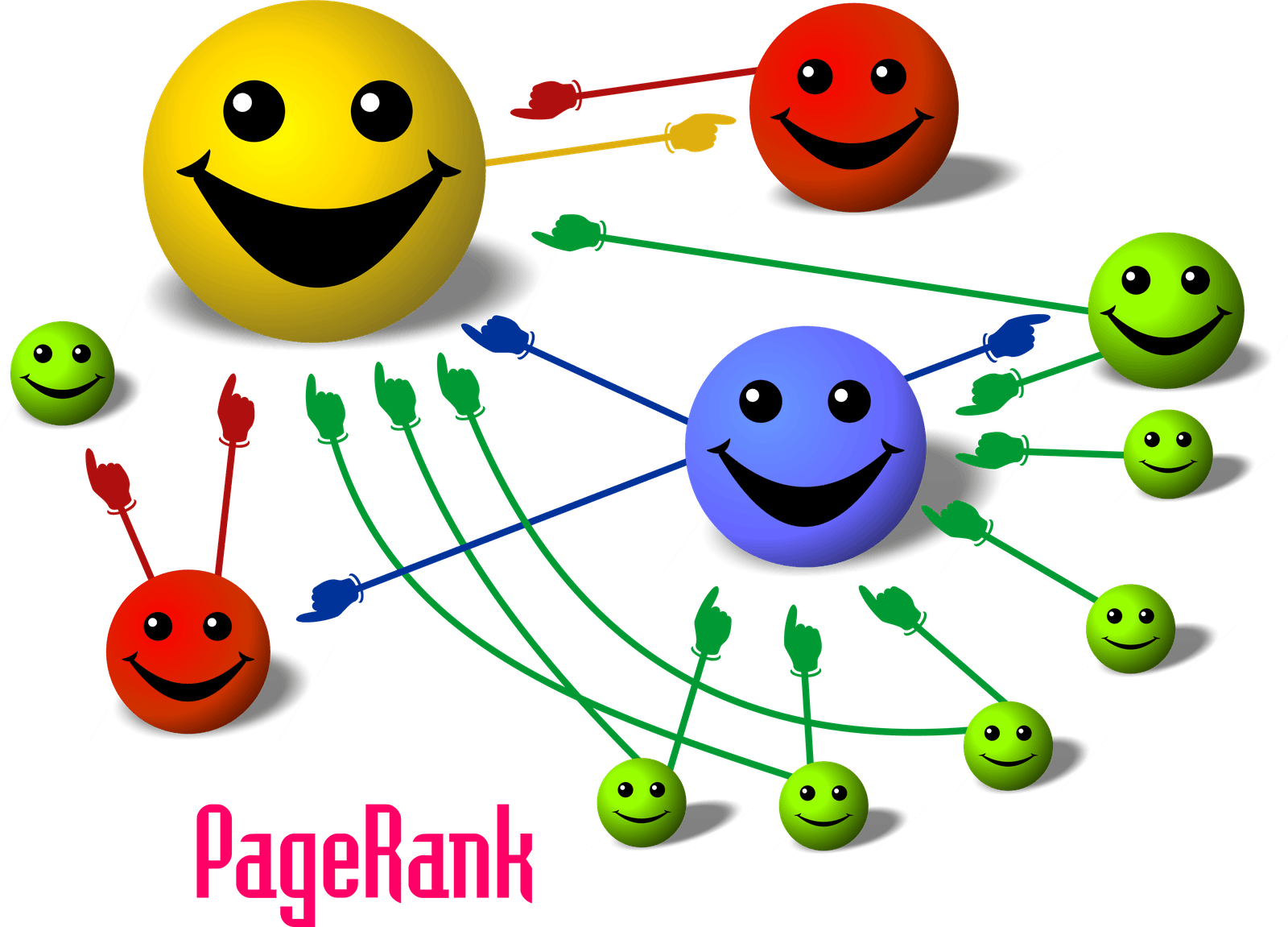
To explain it, they used the random surfer model: a person opens a page at random and keeps clicking links at random, until they get bored and start over from some other page. A page's PageRank is the probability that this person is on that page at any given moment. The more paths lead to a page, and the more those paths start from well-visited pages, the higher the value.
PageRank knows nothing about your search: it only looks at the link graph. That is why Google combines it with the systems that evaluate relevance, quality and much more.
The formula
In the version Brin and Page published in 1998, the formula is:
PR(A) = (1 - d) + d × ( PR(T1)/C(T1) + … + PR(Tn)/C(Tn) )- PR(A): the PageRank of page A.
- T1 … Tn: the pages that link to A.
- C(T): the number of outgoing links on page T.
- d: the damping factor, between 0 and 1, which the authors usually set to 0.85. It is the probability that the surfer keeps clicking instead of starting over.
In plain terms: each page splits its own PageRank equally among the links it contains and passes it to the linked pages, with a small loss due to d. In SEO jargon, this is what's called link juice. A page with a single link passes all its transferable value to that destination; a page with 100 links passes a hundredth to each.
An example with three pages
You only really understand the formula by doing the math. Take a three-page site with these links:
| Page | Outgoing links to | Incoming links from |
|---|---|---|
| A | B, C | C |
| B | C | A |
| C | A | A, B |
With d = 0.85, the three equations are:
PR(A) = 0.15 + 0.85 × PR(C) / 1
PR(B) = 0.15 + 0.85 × PR(A) / 2
PR(C) = 0.15 + 0.85 × ( PR(A) / 2 + PR(B) / 1 )
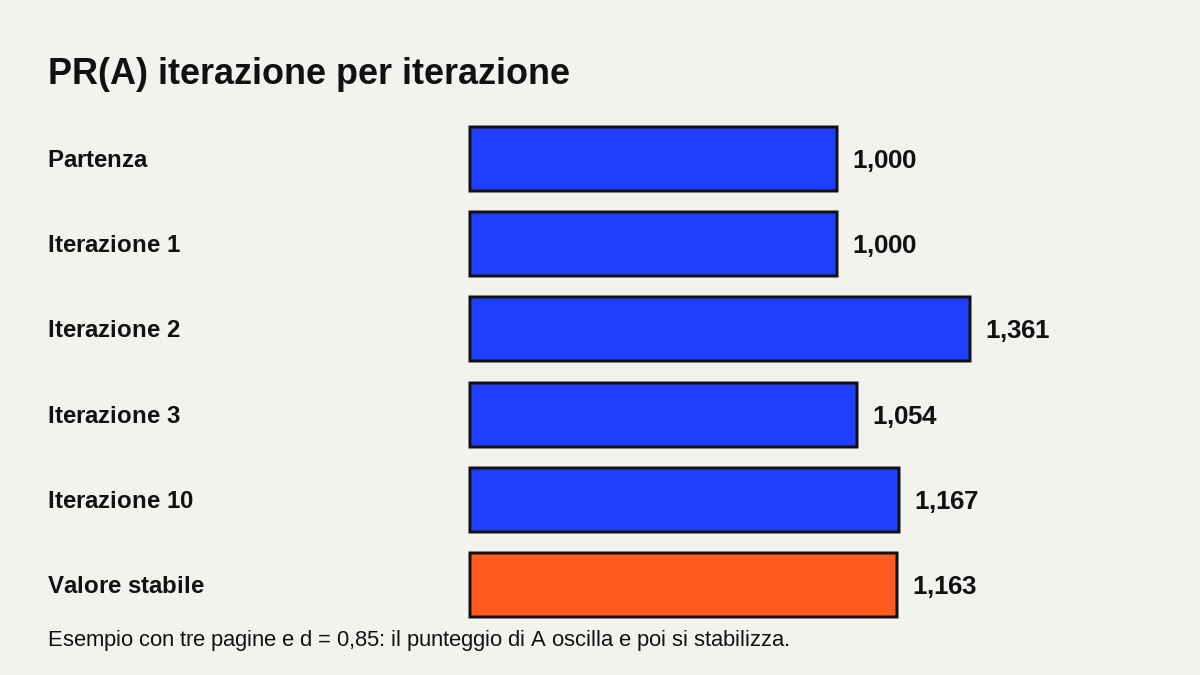
Each value depends on the others, so you start from the same value for every page (1) and repeat the calculation until the numbers stop changing. The first iterations and the final result:
| Iteration | PR(A) | PR(B) | PR(C) |
|---|---|---|---|
| Start | 1.000 | 1.000 | 1.000 |
| 1 | 1.000 | 0.575 | 1.425 |
| 2 | 1.361 | 0.575 | 1.064 |
| 3 | 1.054 | 0.729 | 1.217 |
| 10 | 1.167 | 0.643 | 1.190 |
| Stable value | 1.163 | 0.644 | 1.192 |
What it tells us:
- C wins because it receives two links, from A and from B.
- A is almost level with C even though it receives only one link: that link comes from the strongest page, which links to nothing else and passes all its value to A.
- B comes last: it receives a single link, from A, which splits its value between two destinations.
The lesson for a real site: what matters is where a link comes from and how many other links sit on the same page, not just the number of links. This is a simplified model, the 1998 one: the calculation Google uses today is not public.
Calculating it in a few lines of code
If you want to try it on your own site, you can redo the same calculation in Python. All you need is the list of internal links, which you can export from any crawler such as Screaming Frog:
links = {"A": ["B", "C"], "B": ["C"], "C": ["A"]}
d = 0.85
pr = {p: 1.0 for p in links}

for _ in range(50):
    pr = {
        p: (1 - d) + d * sum(pr[q] / len(links[q]) for q in links if p in links[q])
        for p in links
    }

print({p: round(v, 3) for p, v in pr.items()})
# {'A': 1.163, 'B': 0.644, 'C': 1.192}
On a real site, the result is not Google's PageRank, because it lacks external links and all the adjustments Google applies. But it is a great way to find important pages that receive very few internal links, or pointless pages that receive too many.
How it has changed from 1998 to today
| Year | What happened |
|---|---|
| 1998 | Brin and Page publish the formula at Stanford |
| 2005 | Google introduces rel="nofollow" against comment spam: those links give no ranking credit |
| 2009 | Matt Cutts explains that putting nofollow on some links no longer concentrates the value on the others: PageRank sculpting stops working (the change dated back more than a year earlier, to around 2008) |
| 2010 | Google is granted the "reasonable surfer" patent: not all links on a page are equally likely to be clicked |
| 2016 | Google confirms it has removed public PageRank from the toolbar |
| 2019 | Nofollow, sponsored and ugc become hints rather than directives |
The reasonable surfer patent deserves a couple of lines. Filed in 2004 and granted in 2010, it describes a model in which a link's weight depends on how likely it is to be clicked: position on the page, text size, relatedness between the two pages, link type. In the patent, links near the top of the page are more likely to be clicked, while banners and links to terms of service are among the rarely followed ones. A word of caution, though: a patent shows an idea, not that Google uses it today exactly as written. For details, see the entry on the reasonable surfer.
And the original patent? It is US6285999B1, originally assigned to Stanford University and granted in 2001. According to Google Patents, it has expired at the end of its term: the expected expiration date was January 9, 2018, twenty years after filing. That means the method is no longer protected, not that Google has abandoned it: PageRank remains among its core ranking systems. Dates, claims and patent family are in the PageRank patent page; for the other patents that matter for SEO, see the guide to Google patents.
PageRank today
Does it still matter? Three facts.
- Google still uses it. The Guide to ranking systems confirms it: link analysis systems understand what pages are about and which are most useful, and PageRank is one of the core ranking systems, used since Google launched and much evolved since then.
- It is no longer the king of factors. In September 2023, Google's Gary Illyes said that links have not been among the top three ranking factors "for a while" and that you can rank a page without links. Important, yes, but less so than people think.
- It also weighs on AI answers, indirectly. AI Overviews and AI Mode rely on Search's ranking and quality systems to choose the pages to draw from. It is reasonable to infer that if links help a page rank, they also help it get retrieved as a source; but it remains an inference. It is not known how much PageRank weighs in that choice, and Google advises against seeking inauthentic mentions on the web.
A note on the metrics you see in SEO tools: domain authority, URL rating and similar are not Google data. They are third-party estimates, useful for comparing sites, but they are not PageRank.
Internal links: how to distribute value across your site
Internal links are the only part of PageRank you control 100%. A practical checklist:
- Use real links. Google generally only follows links with the
<a>element and thehrefattribute. JavaScript-only buttons orhref="javascript:…"are not reliable. - No important orphan pages. Every page that matters must receive at least one link from another page on the site.
- Link from the top to the pages that make you money. Back in 2009, Matt Cutts described choosing what to link from the home page as a better and more effective way to direct PageRank. Your main services and products should be a few clicks from the home page.
- Descriptive anchor text. "Link building service" tells Google and the reader where the link leads; "click here" does not. Without forcing the keyword: it can violate the spam policies.
- Don't dilute value. There is no ideal number of links, but every extra link divides the value.
- Don't use nofollow on internal links to "sculpt". Since around 2008 (it has been discussed since 2009) it doesn't concentrate value on the other links: it wastes it.
- Fix broken links and redirect chains. A link to a page that doesn't exist is wasted value.
The script above, run on your list of internal links, tells you whether the page that brings you clients is among the most linked or is buried at the bottom.
External links: what to do and what to avoid
My first penalty came from pure spam. Since then I run spam tests on my own projects, never on clients' ones: if you only do white hat, you never understand where the line is. On links, Google has put the line in black and white in its spam policies.
| Practice | What Google says |
|---|---|
| Buying or selling links that pass credit | Link spam. Paid links must be flagged with rel="sponsored" or nofollow |
| Guest posts or press releases with optimized anchor text | Link spam if they are meant to increase ranking credit |
| Excessive link exchanges ("I'll link to you if you link to me") | Link spam |
| Links added by users in comments and forums | Google recommends flagging them with rel="ugc" (nofollow is fine too) |
| Content that others cite spontaneously | This is the ideal case: a good sign if important sites point to your content |
| Rejecting links with disavow | Only needed if you have many spam links that caused, or are likely to cause, a manual action |
If Google finds artificial links, it can ignore them or, in serious cases, apply a manual action: that is the story of Penguin. If it has already happened to you, the starting point is the Google penalty recovery service.
The clean way to grow the value of your links is to have something worth citing: original data, guides that answer better than the others, useful tools. Then let the people who write about your industry know about it. For a basic guide on what a link is and how it works, see our introduction.
Want links that bring value without risking penalties? Take a look at the link building service, or restructure your strategy starting from your site's data with the SEO audit: you get the 5 things to fix first, looking at internal links and your backlink profile too.
PageRank is only one of Google's systems: the full picture is in the guide on how Google works.
Frequently asked questions
Do nofollow links pass PageRank?
As a rule, no, but it is no longer an absolute rule. Since September 10, 2019, Google treats nofollow, sponsored and ugc as hints: it generally doesn't consider those links for ranking, but it may use them as information. For paid links, the sponsored or nofollow attribute is still required, because Google's policies consider them link spam.
How do you increase the PageRank of a page?
With internal links from the strongest pages on the site, starting from the home page, with descriptive anchor text and no important orphan pages; and with spontaneous external links from related sites, which come if you publish content worth citing. Buying links or using guest posts with anchor text optimized for ranking violates Google's spam policies.
Does PageRank also matter for AI Overviews and AI Mode?
Indirectly. AI Overviews and AI Mode rely on Search's ranking and quality systems to retrieve the pages to cite, and PageRank is one of those systems. It is not known how much it weighs in the choice of sources, and Google advises against seeking inauthentic mentions to appear in AI answers.


