
How Search Engines Work
A search engine crawls pages, stores them in its index and, at every search, picks the most useful ones. What happens at each stage, how AI changes it and which search engines are used in Italy.

Eugenio Tommasi
Founder of SEO SRL
Published 7 min read

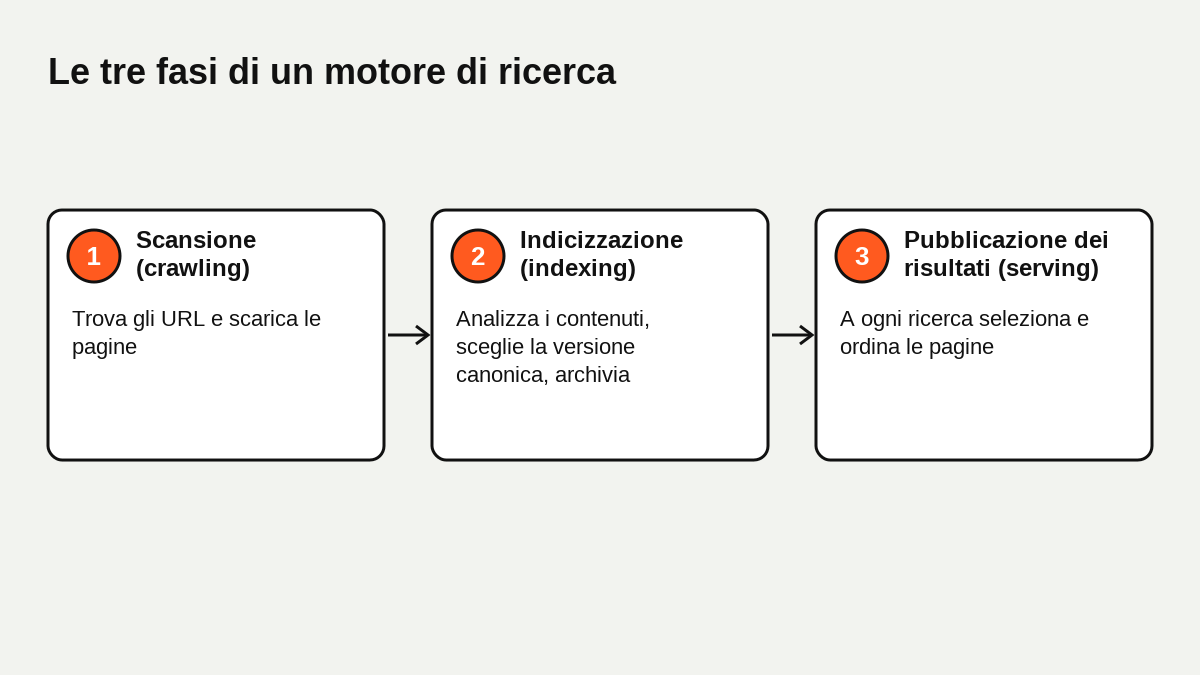
A search engine works in three stages: it crawls the pages of the web with its crawlers, stores them in its index and, at every search, picks and orders the most useful ones.
Table of contents (9 sections)
- Crawlers, index and algorithms
- The three stages: crawling, indexing, ranking
- 1. Crawling: how the search engine finds pages
- 2. Indexing: how the search engine understands and stores pages
- 3. Ranking: how the search engine chooses what to show
- What about AI-based search engines?
- Where to start
- The most used search engines
- Frequently asked questions
A search engine works in three stages: it crawls the pages of the web, stores them in its index and, at every search, picks and orders the most useful ones. When a client asks me why their page doesn't show up, I always start here: you need to work out at which of the three stages it stops. For each stage I use Google as the example and tell you what I check in Search Console.
Crawlers, index and algorithms

There are three components: crawlers visit the pages, the index stores them, and algorithms decide what to show. Google's index contains hundreds of billions of pages and is well over 100 million gigabytes. It works like the index at the back of a book, with an entry for every word and the pages where it appears. The process is automatic: Google does not accept payment to crawl a site more often or to rank it higher in organic results.
The three stages: crawling, indexing, ranking
| Stage | What the search engine does | Question for your site |
|---|---|---|
| 1. Crawling | Finds URLs and downloads the pages | Can Google reach and read my pages? |
| 2. Indexing | Analyzes the content, picks the canonical version, stores it | Are my important pages in the index, one version each? |
| 3. Serving results | At every search, selects and orders the pages | Are my pages the best answers for the right searches? |
Not every page makes it through all three stages. Even a site that follows all of Google's guidelines is not guaranteed to be crawled, indexed or shown.
1. Crawling: how the search engine finds pages
There is no central registry of all the pages on the web. A search engine discovers them mainly in two ways: by following links from pages it already knows and by reading sitemaps, the lists of URLs that sites submit to it. Then a crawler (for Google, Googlebot) downloads the page, extracts its links and starts over.
Many pages today build their content with JavaScript. That's why Googlebot also does rendering: it runs the code with a recent version of Chrome and sees the page more or less as a person does, including content loaded later.
The crawler doesn't crawl everything, and not always:
- it skips pages blocked by
robots.txtand those behind a login; - it slows down if the server responds slowly or with errors, so as not to overload it;
- it comes back more often to pages that change frequently and to those considered important.
The "crawl budget" is the set of URLs that Google can and wants to crawl on a site: it depends on the server's capacity and on interest in the content. It mainly concerns large sites, roughly those with over a million unique pages that change about once a week, or over 10,000 pages that change every day (these are estimates, not precise thresholds), as described in Google's crawl budget guide. For a site of a few hundred pages I don't consider it a problem, and I often see time wasted worrying about it.
What to check in Search Console. With the URL Inspection tool you paste the address and read "Crawl allowed?" (whether robots.txt blocks it), "Last crawl" and "Crawled as" (desktop or mobile). Then, in Settings, the Crawl stats report: total requests, average response time and server responses (200, 404, 5xx errors), plus host status. Under a thousand pages I don't look at it in detail. If you've submitted a sitemap, the Sitemaps report shows whether Google has read it.
2. Indexing: how the search engine understands and stores pages
Once the page is downloaded, the search engine tries to understand what it's about: it analyzes the text, the title, the headings, alt attributes, images, videos and structured data. Then it deals with a problem few people imagine: duplicates. The same content can live at several addresses (with and without www, with parameters, in printable versions), and the search engine groups them and picks one as the canonical, the one that can appear in results.
Finally it stores the page in the index along with a set of signals: language, country it targets, usability, freshness. Not everything gets in: near-empty pages, duplicates, pages with a noindex tag or judged not useful enough stay out. The practical side is in the guide on how to index your site.
What to check in Search Console. The Page indexing report splits URLs into indexed and not indexed and, in the "Why pages aren't indexed" table, gives the reasons, for example "Crawled - currently not indexed", "Discovered - currently not indexed", "Excluded by 'noindex' tag" or "Duplicate without user-selected canonical". In URL Inspection, on a single page, you look at "Indexing allowed?" and compare the "User-declared canonical" with the "Google-selected canonical": if they differ, Google has chosen another version. "Test live URL" shows the page as it is now, not as it was last indexed.
3. Ranking: how the search engine chooses what to show

When someone searches, the search engine doesn't scroll through the web: it queries the index, finds the matching pages and orders them. Relevance depends on several factors, which Google groups into five areas: the meaning of the query, the relevance of the content, its quality, the usability of the pages and the searcher's context. The old figure of "over 200 factors" has circulated for years but shouldn't be taken literally.
Context weighs more than you might think. The same search returns different results depending on:
- location: "pizzeria" shows places near the searcher;
- language and country;
- device;
- history and settings, if the user has turned them on.
The end result is the SERP, which today is not just a list of links: alongside organic results it can contain ads, maps, images, videos, direct answers and, for some searches, an AI-generated overview. The systems working behind the scenes, from PageRank to artificial intelligence, are covered in how Google really works.
What to check in Search Console. The Performance report shows clicks, impressions, click-through rate and average position, which you can group by page or by query. For a page that isn't climbing, look at which searches it appears for and at what position, then open the SERP for that search to see who is ahead and what type of page Google prefers. If the page is indexed but doesn't appear, the problem is no longer about crawling.
What about AI-based search engines?
Generated answers don't replace the three stages, they build on them. Google's generative AI features, such as AI Overviews and AI Mode, rely on Search's ranking and quality systems: to appear among the sources, a page must be indexed and eligible to be shown with a snippet, and no special files are needed. Assistants like ChatGPT also need to be able to read pages in order to answer with up-to-date information: for ChatGPT search, the OAI-SearchBot crawler matters, which I cover in the guide to GPTBot and OpenAI's bots.
What changes most is the last step: instead of a list of links, the searcher gets an answer that cites a few sources. How to get picked among those sources is the topic of GEO.
Where to start
Order matters: there's no point rewriting the text of a page that Google can't crawl. Check crawling first, then indexing, and finally rankings. It's the mistake I see most often: people work on content when the problem lies two stages earlier. The basics for working on all three stages are in the guide to what SEO is, and choosing the right searches is covered in the one on keywords.
The most used search engines
| Search engine | Share in Italy (Sept 2025-Sept 2026) | Worldwide share (Sept 2026) | Notes |
|---|---|---|---|
| 87.3% | just under 90% | Over 5 trillion searches a year (March 2025) | |
| Bing | about 6% | 5.3% | Owned by Microsoft; its results are also used by other services |
| Yandex | marginal | about 1.3% | Concentrated in Russian-speaking countries |
| Baidu | marginal | 0.44% | Dominates in China, where Google is not accessible; worldwide statistics underestimate it |
The data comes from StatCounter, which calculates it from visits to sites that use its analytics service: these are estimates, useful for proportions. For an Italian site, Google comes first by far, but Bing is not zero, and checking it with Bing Webmaster Tools takes only a few minutes.
Want to know at which stage your site gets stuck? Find out what's wrong: request the SEO audit.
Frequently asked questions
Can you pay Google to get indexed or ranked higher?
No. Google does not accept payment to crawl a site more often or to rank it higher in organic results, and even following all of its guidelines doesn't guarantee crawling, indexing or ranking. Paying only gets you into ad spaces, labeled "Sponsored".


