
RankBrain: What It Is and How Google's AI Works
RankBrain is the machine learning system Google has used since 2015 to connect the words in searches to concepts. How it works, what emerged from the 2023 testimony, the CTR and dwell time myth, and its role alongside BERT and AI Mode.

Eugenio Tommasi
Founder of SEO SRL
Published 7 min read

RankBrain is the artificial intelligence system Google has used since 2015 to connect the words in searches to concepts, so it can show relevant pages even without the exact words of the query, especially for new searches.
Table of contents (9 sections)
RankBrain is the artificial intelligence system Google has used since 2015 to connect the words in searches to concepts. It lets Google find relevant pages even when they don't contain the exact words of the query, especially for searches it has never seen before. It was the first deep learning system used in Search, and it is still active.
Theories about clicks and dwell time have circulated around RankBrain for years. I separate what Google has said, even under oath in 2023, from what has simply been repeated.
RankBrain in brief
| Question | Answer |
|---|---|
| What it is | A machine learning system that connects words to concepts |
| Since when | 2015; revealed in October 2015 by a Bloomberg article |
| Milestone | First deep learning system used in Google Search |
| Where it intervenes | Reorders the top 20-30 results, according to Pandu Nayak's 2023 testimony |
| Most useful for | Rare or new queries, the long tail |
| Does it use CTR and dwell time? | Google has never confirmed it |
| Status today | Active system in Google's guide to ranking systems |
How it works: from words to concepts
Before machine learning, query processing relied on rules written by engineers: stemming (reducing “swim,” “swimming” and “swimmer” to the same root), synonyms, entities such as people and places. It worked for common searches, much less for ones never seen before.
That is a big problem: in 2022 Google stated that 15% of searches every day are completely new. Nobody can write rules for queries that don't exist yet.
RankBrain tackles the problem by learning from data. Google's official example is the search “what's the title of the consumer at the highest level of a food chain.” A keyword-based system could read “consumer” in the commercial sense. RankBrain, which has seen those words on a huge number of pages, links “food chain” to animals and understands that the person is looking for the concept of an “apex predator,” the predator at the top of the food chain.
It works the same way in any language. Take the searches “what are the most populated countries in the world” and “countries by population.” They are worded differently but ask for the same thing. A system that connects words to concepts can recognize this and show similar results for both, even if the first is rare and the second common.
Word vectors and Word2Vec
How does a machine “know” that two sentences are about the same thing? By turning words into numbers. RankBrain converts language into vectors: points in a mathematical space where words with similar meanings sit close together.
The idea didn't start with RankBrain. On August 14, 2013, Google open-sourced Word2Vec, a tool that learns these representations by reading large amounts of text. Google's example: after reading a huge number of news articles, with no human guidance, Word2Vec places countries and capitals so that the distance between France and Paris is similar to the one between Germany and Berlin.
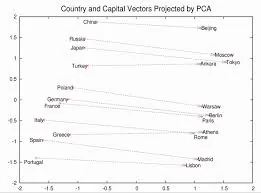
Google noted that it provided no supervised information during training: the “capital of” relationship emerges on its own from the texts. This is the kind of learning that lets RankBrain handle questions nobody has ever written before.
What Google said under oath
For years, information about RankBrain was scarce. In October 2023, at the antitrust trial against Google in the United States, Pandu Nayak, Google's vice president of Search, gave details Google had never made public:
- It works on the top 20-30 documents. RankBrain reviews results that have already been selected and can modify their score. It doesn't evaluate the whole index.
- It's expensive. It costs more than other ranking components, which is why it doesn't run on hundreds or thousands of results.
- It's trained on queries in all languages. It isn't an English-only system.
- It understands the long tail. Nayak said RankBrain understands long-tail needs as it trains.
- DeepRank absorbs part of it. DeepRank, meaning BERT used for ranking, is taking on more and more of RankBrain's capabilities.
Many details of the testimony were redacted, so the picture remains partial. But it is the most direct source available, along with the internal documents leaked in 2024 that I cover in the article on the Google leak.
Is RankBrain the third ranking factor?
The phrase comes from here: in 2015, in the Bloomberg interview that revealed RankBrain's existence, Google researcher Greg Corrado called it the third most important signal for results. In March 2016, Andrey Lipattsev, Search Quality Senior Strategist at Google, named the other two: content and links pointing to the site, in no particular order, as he himself specified.
Since then Google has dismantled the idea of a fixed ranking several times. In September 2023 Gary Illyes said that links have not been among the top three factors “for a while” and that the most important factors vary from site to site.
My reading: “third factor” was a 2015 soundbite, not a rule. RankBrain isn't a signal you can raise or lower: it's a system that interprets the search.
Does RankBrain use CTR and dwell time? Facts and myths
Many articles claim that RankBrain measures user satisfaction through CTR (the percentage of clicks on results), dwell time (the time spent on a page before returning to the results) and bounce rate. Here is the picture.
| Claim | What the evidence says | Source |
|---|---|---|
| RankBrain uses SERP CTR | Never confirmed. In 2019 Gary Illyes called the dwell time and CTR theories tied to RankBrain “generally made up” | Search Engine Journal, 2019 |
| RankBrain uses historical search data | Yes: according to Illyes, it uses it to predict what a user would click for a query never seen before | Search Engine Journal, 2019 |
| Google uses clicks for ranking | Yes, but with a different system: according to Nayak, Navboost is trained on user clicks from the last 13 months and is one of the important signals | Search Engine Land, 2023 |
| Google uses Analytics bounce rate | No confirmation. Google says it uses aggregated, anonymized interaction data to assess relevance, not an individual site's statistics | How Search Works |
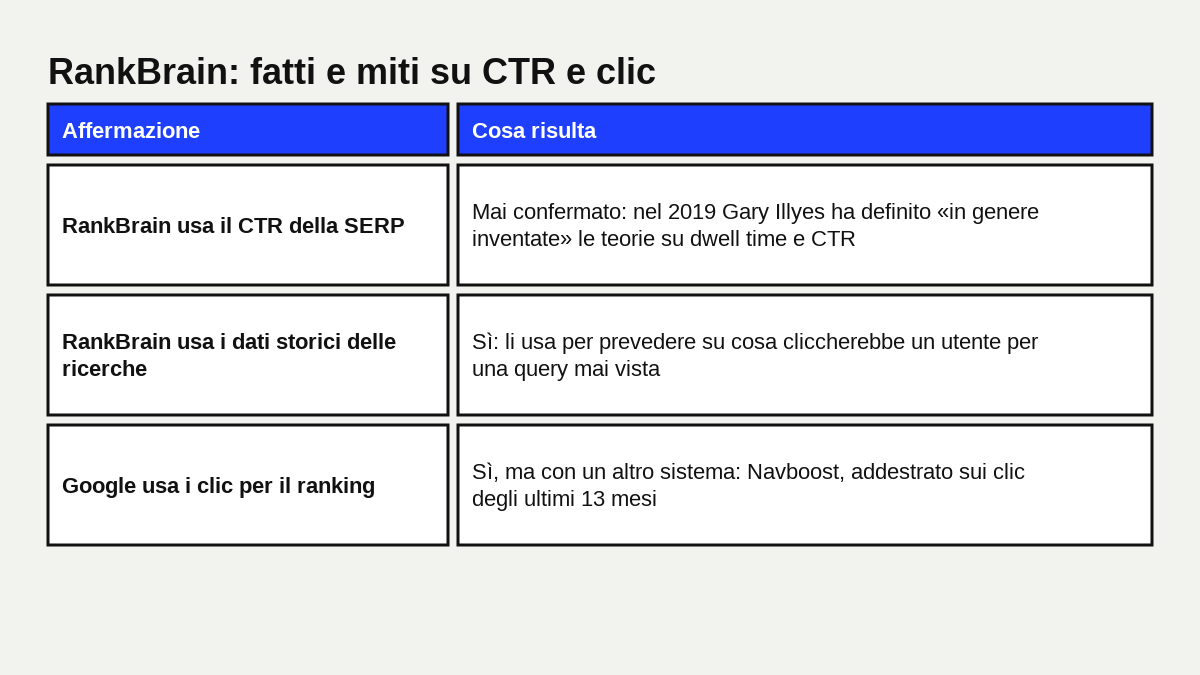
The practical point: clicks matter to Google, but not in the “raise your CTR and climb” way you read about everywhere. A title that promises what the page doesn't deliver brings clicks that bounce back. There's no point building a strategy on that.
RankBrain today: BERT, MUM, AI Overviews and AI Mode
RankBrain is still among Google's active ranking systems, alongside neural matching, BERT and passage ranking. MUM, introduced in 2021, isn't used for general ranking. Google describes it as one of Search's main AI systems, working together with the others.
What about generated answers? AI Overviews and AI Mode are built on Search's ranking and quality systems: they retrieve pages from the index and show links to sources. AI Mode also uses query fan-out: it generates a series of related searches to find more results.
On this point Google doesn't say which systems come into play, one by one, in the searches generated by fan-out. It's plausible that RankBrain and BERT work there too, because they are active ranking systems and fan-out produces exactly the new, long queries that are RankBrain's territory. But that is an inference, not a statement from Google.
What it means for SEO
RankBrain made a very common practice pointless: one page for every variant of the same search. If Google links “most populated countries in the world” and “countries by population” to the same concept, ten nearly identical pages compete with each other.
The long tail is still important, though: it's exactly that 15% of new searches where RankBrain helps most. What changes is how you cover it:
- Group by intent. Put together the variants that ask the same thing and build a single, complete page.
- Cover sub-questions on the same page. One section for each, with a clear heading. It serves the reader and the related searches from fan-out.
- Write in natural language. The system links concepts, it doesn't count words: forcing the keyword doesn't help.
- Use the vocabulary of the field. The terms someone who knows the topic would use anyway (“apex predator,” not “strongest animal”) help connect the page to the right concept.
- Keep title and meta description truthful. They should describe what the page delivers, not promise more to win a click.
- Update old pages instead of opening a duplicate.
The rest is a good SEO strategy: knowing who is searching, what they want and which pages of the site should answer.
Do you have several pages competing for the same searches? It's one of the problems I fix in the website ranking service. Want to start by seeing where you're losing visits? Here's where to begin: get the 5 things to fix first on your site.
For the big picture of Google's systems, see the guide on how Google works; for the system that paved the way, read the article on Hummingbird.
Frequently asked questions
Does RankBrain use CTR and dwell time?
Google has never confirmed it. In 2019 Gary Illyes called the theories about dwell time and CTR generally made up, explaining that RankBrain uses historical search data to predict what a user would click for a query never seen before. User clicks are used by a different system, Navboost, with data from the last 13 months: Pandu Nayak said so in his 2023 testimony.
Can you optimize a website for RankBrain?
Not specifically. It's better to group the variants of a search that share the same intent into a single complete page, cover sub-questions with clear sections, write in natural language and use titles that truly describe the page. Creating a page for every keyword variant only produces pages that compete with each other.


