
Google Updates: The Complete Timeline of Algorithm Changes
The timeline of Google updates from 2000 to today, with the official dates of recent core updates, how long they last and what to do when your traffic drops.

Eugenio Tommasi
Founder of SEO SRL
Published 11 min read

A Google update is a change to the systems that decide the order of search results; core updates, announced several times a year, broadly change how content is evaluated.
Table of contents (11 sections)
- Core updates, spam updates and the other types of update
- Recent updates, with official dates
- How long does a core update last?
- Timeline: 2000-2010, from the toolbar to Caffeine
- Timeline: 2011-2016, the Panda and Penguin years
- Timeline: 2017-2021, mobile, speed and language
- Timeline: 2022 to today, helpful content, spam and AI
- What to do when a core update arrives
- Traffic drop: core update, spam, manual action or technical problem?
- What 25 years of updates teach
- Frequently asked questions
Google updates are changes to the systems that decide the order of search results. Small tweaks ship almost every day without any announcement; several times a year, though, Google releases a core update, which can push a site up or down even if it did nothing wrong.
This timeline covers the most important updates from 2000 to today, with the official dates from Google's dashboard for recent ones, and is current as of October 8, 2026.
Core updates, spam updates and the other types of update
Not all updates are the same. Before looking at the dates, it helps to know what is actually changing:
| Type | What changes | Announced? | What to do |
|---|---|---|---|
| Core update | A broad revision of how the systems evaluate content. It does not target one specific practice. | Yes, on the Search Status Dashboard. Minor ones are not. | Wait for it to finish, then assess the quality of the pages that lost. |
| Spam update | Strengthens the systems that detect spam, such as SpamBrain. | Yes | Check whether the site uses practices banned by the spam policies. |
| Targeted updates (helpful content, reviews, Discover) | Affect a specific system or type of content. | Yes, when they are significant | Reread Google's guidance on that topic. |
| Manual action | A Google reviewer penalizes a site that violates the policies. | Yes, in Search Console, only to you | Fix the problem and request a review. |
Many of the historic names you'll read below (Boston, Florida, Fred, Medic) were given by the SEO community, not by Google. For several years now Google has used descriptive names: “March 2025 core update”, “August 2025 spam update”.
Recent updates, with official dates
Since 2021 Google has published ranking updates on its Search Status Dashboard. These are the ones from 2024 onward, with the start date (Pacific time) and the length of the rollout:
| Update | Start | Duration |
|---|---|---|
| September 2026 spam update | September 24, 2026 | 13 days 16 hours |
| August 2026 spam update | August 18, 2026 | 2 days 16 hours |
| June 2026 spam update | June 24, 2026 | 2 days |
| May 2026 core update | May 21, 2026 | 11 days 21 hours |
| March 2026 core update | March 27, 2026 | 12 days 4 hours |
| March 2026 spam update | March 24, 2026 | 19 hours 30 minutes |
| February 2026 Discover update | February 5, 2026 | 21 days 17 hours |
| December 2025 core update | December 11, 2025 | 18 days |
| August 2025 spam update | August 26, 2025 | 26 days 15 hours |
| June 2025 core update | June 30, 2025 | 16 days 18 hours |
| March 2025 core update | March 13, 2025 | 13 days 21 hours |
| December 2024 spam update | December 19, 2024 | 7 days |
| December 2024 core update | December 12, 2024 | 6 days 4 hours |
| November 2024 core update | November 11, 2024 | 23 days 13 hours |
| August 2024 core update | August 15, 2024 | 19 days 4 hours |
| June 2024 spam update | June 20, 2024 | 7 days |
| March 2024 spam update | March 5, 2024 | 14 days 21 hours |
| March 2024 core update | March 5, 2024 | 45 days |
For 2021-2023 the same dashboard records, among others, the core updates of November 2021, May and September 2022, and March, August, October and November 2023, the helpful content updates (August and December 2022, September 2023), the product reviews updates and the December 2022 link spam update. You'll find them in the timeline below.
How long does a core update last?
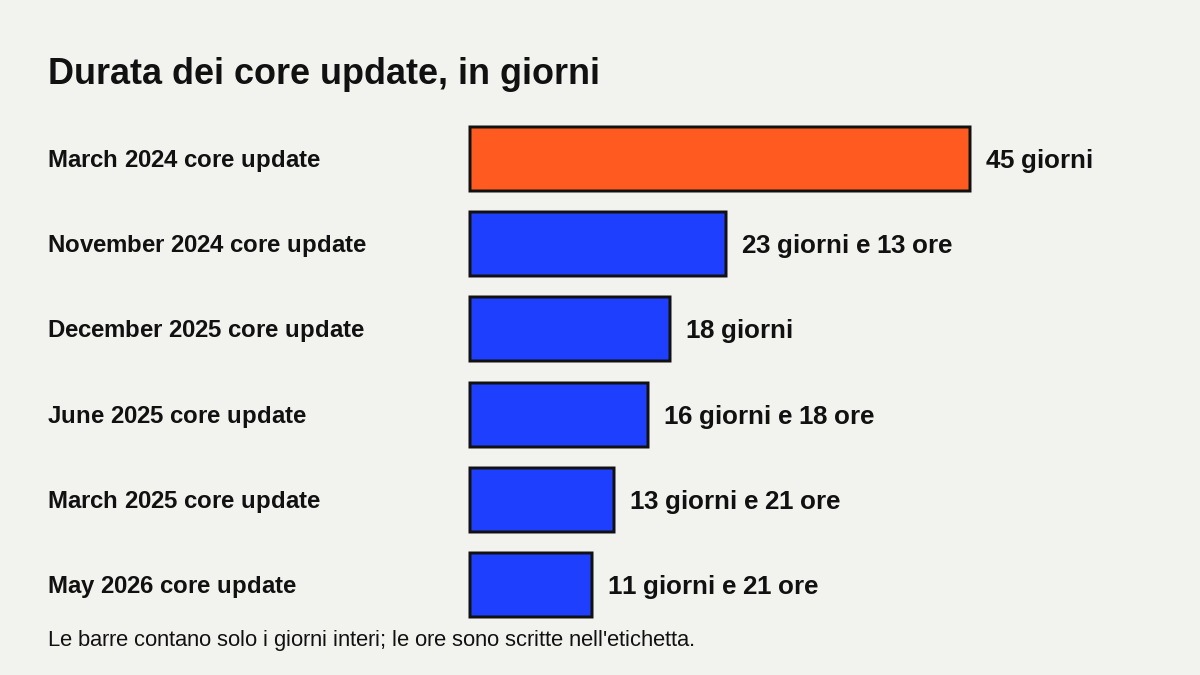
I calculated from the dashboard the duration of the nine core updates from 2024 to May 2026: the shortest lasted 6 days (December 2024), the longest 45 (March 2024, the one that absorbed the helpful content system). The median is about 17 days, and six out of nine lasted between roughly 12 and 19 days.
Two practical things follow. First, rankings bounce around during the rollout: judging a core update after three days means measuring noise. Second, in the table there are four core updates in 2024, three in 2025 and two so far in 2026: a site that lost traffic usually has a few months to improve before the next one.
Timeline: 2000-2010, from the toolbar to Caffeine
| Date | Update | What it changed |
|---|---|---|
| December 2000 | Google Toolbar | The browser bar shows the PageRank of pages, from 0 to 10. The public value was removed in 2016; PageRank remains among the internal signals. |
| February 2003 | Boston | The first named update, announced at the SES conference in Boston: the index is refreshed more often. |
| April 2003 | Cassandra | Targets hidden links and hidden text. |
| November 2003 | Florida | Hits 1990s techniques such as keyword stuffing. For many, the beginning of modern SEO. |
| January 2005 | Nofollow | Google, Yahoo! and Microsoft introduce the attribute to flag links that should not be counted, created to fight comment spam. |
| May 2005 | Bourbon | Works on duplicates and non-canonical URLs. |
| June 2005 | Personalized search and XML sitemaps | Results take the user's history into account; sitemaps arrive. |
| December 2005 – March 2006 | Big Daddy | An infrastructure update: changes how canonicalization and redirects are handled. |
| May 2007 | Universal Search | News, images, video and other vertical results are blended into the classic results. |
| August 2008 | Google Suggest | Suggestions as you type, today's autocomplete. |
| April – May 2010 | MayDay | Changes the ranking of long-tail searches, hitting sites with many thin pages. |
| June 8, 2010 | Caffeine | New indexing system: faster crawling, fresher results. |
| September 2010 | Google Instant | Results shown as you type. Discontinued in 2017. |
Timeline: 2011-2016, the Panda and Penguin years
| Date | Update | What it changed |
|---|---|---|
| February 24, 2011 | Panda | Against thin content and content farms: 11.8% of searches in the United States. In Italy in August 2011. |
| April 24, 2012 | Penguin | Against webspam and artificial links: about 3.1% of English-language searches. |
| September 2012 | Exact Match Domain | Less advantage for domains that repeat the search query word for word. Still among the active systems today. |
| August 2013 | Hummingbird | The overhaul of the ranking systems, announced in September: Google interprets the meaning of the search, not just the words. |
| May 2014 | Panda 4.0 | One of the heaviest versions of Panda. |
| July 2014 | Pigeon | Changes local search in the United States: more weight on relevance and distance. The name was coined by the industry press. |
| August 7, 2014 | HTTPS | The secure protocol becomes a “very lightweight” signal: fewer than 1% of searches at launch. |
| April 21, 2015 | Mobile-friendly | Mobile-friendly pages rank higher in mobile searches in all languages. |
| 2015 | Panda in the core | Panda joins the core systems: no more dated Panda updates. |
| 2015 (made public in October) | RankBrain | The first machine learning system announced in ranking: it connects words to concepts. |
| September 23, 2016 | Penguin 4.0 | Penguin joins the core algorithm, works in real time and devalues spam instead of penalizing the whole site. |
Timeline: 2017-2021, mobile, speed and language
| Date | Update | What it changed |
|---|---|---|
| January 2017 | Intrusive interstitials | Pages covered by intrusive pop-ups are penalized on mobile. |
| March 2017 | Fred | Sharp drops for thin-content sites packed with ads or affiliate links. The name comes from a joke by Gary Illyes. |
| March 2018 | Mobile-first indexing | Google starts using the mobile version of pages to index them. The switch was completed for all sites in July 2024. |
| July 2018 | Speed Update and Chrome 68 | Speed also counts in mobile searches; Chrome labels all HTTP sites as “Not secure”. |
| August 2018 | Medic | A core update that mainly hit health and wellness sites. Name coined by the industry press. |
| March and June 2019 | Core updates | March 12 and June 3; in June the site diversity system also arrives: as a rule, no more than two results from the same site. |
| October – December 2019 | BERT | The language model that reads words in the context of the sentence. On December 9 it was extended to more than 70 languages, Italian included. |
| 2020 | Core updates | January 13, May 4 and December 3, plus a few indexing bugs between August and October. |
| February 2021 | Passage ranking | Google also evaluates individual sections of a page, first in English in the United States. |
| November – December 2021 | Core, spam and reviews | Core update on November 17, spam update on November 3, product reviews update from December 1. |

Timeline: 2022 to today, helpful content, spam and AI
| Date | Update | What it changed |
|---|---|---|
| February 2022 | Page experience on desktop | Page experience signals also arrive in desktop searches. |
| August 2022 | Helpful content | The system against content written for search engines instead of people is born. New releases in December 2022 and September 2023. |
| December 2022 | Link spam update | SpamBrain identifies sites that buy links and domains used mainly to pass links to other sites, and nullifies the value of unnatural links. |
| 2022-2023 | Reviews | Multiple releases of the system that rewards reviews with in-depth analysis and firsthand evidence. |
| October 2023 and August 2024 | Ranking issues | Two incidents logged on the dashboard during the same period as a core update: a drop on those days can have more than one cause. |
| March 5, 2024 | Core update and new spam policies | The helpful content system joins the core. New policies arrive on scaled content abuse, expired domain abuse and site reputation abuse. |
| 2024 – 2026 | Core and spam updates | Two to four core updates a year and recurring spam updates (table above). |
| March 26, 2025 | AI Overviews in Italy | AI-generated summaries at the top of the SERP arrive in Italian. |
| October 8, 2025 | AI Mode in Italy | The conversational search mode arrives in Italian. |
| February 2026 | Discover update | An update dedicated to Google Discover, which lasted about three weeks. |
Today Panda, Penguin, Hummingbird and the helpful content system no longer exist as separate systems: Google lists them among the “retired” systems, because their criteria have been absorbed into the core systems. Among the active ones are BERT, RankBrain, passage ranking, the reviews system, link analysis with PageRank and spam detection with SpamBrain.
What to do when a core update arrives
This is the procedure I follow:
- Don't touch anything during the rollout. Rankings fluctuate for days. Changing pages at that point makes it impossible to tell what worked.
- Note the dates. You'll find the start and end on the dashboard. Wait at least one full week after it ends.
- Compare two weeks. In Search Console, Performance report, compare the week after the end of the rollout with the week before the start.
- Isolate the pages and queries that lost. A drop spread across the whole site tells a different story from a drop on ten pages. Also check whether you lost rankings (say, from 2 to 6) or only clicks at the same position.
- Look at who overtook you. Open the SERP: what do the pages that moved up do better? The answer is often right there, and it's not “they have more words”.
- Assess your pages honestly. Use the questions in Google's helpful content guide: original information, firsthand experience, sources, a clear author, a complete answer.
- Improve, merge or delete. Update the pages that deserve it, merge those that overlap, remove those that serve no one.
- Give it time. Some improvements show up in a few days, others take months; sometimes you need the next core update.
Changing only the date of an old article doesn't help: among the questions to ask yourself, Google's helpful content guide includes exactly the one about dates changed without the content changing substantially. It's better to really update the content, with new data and clearer answers.
Traffic drop: core update, spam, manual action or technical problem?
Not every drop is caused by an update. Before rewriting half your site, rule out the other causes:
| Cause | Clues | Where to check |
|---|---|---|
| Core update | The drop coincides with a rollout, affects many pages, rankings fall gradually | Search Status Dashboard, Performance report |
| Spam update | Sharp drop on a site that uses bought links, mass-produced content or pages hosted for third parties | Google's spam policies, link profile |
| Manual action | Sudden drop, even outside rollouts | Search Console, Manual actions report |
| Technical problem | Pages dropped from the index, server errors, noindex or robots.txt changed after a site release | Pages report and Crawl stats in Search Console |
| SERP change | Stable position but fewer clicks: AI Overviews, new boxes, more ads | Performance report (impressions versus clicks), the SERP itself |
| Seasonality | The same drop happened the year before | Year-over-year comparison |
If you find a manual action or signs of spam, the work is different: I cover that in the page on Google penalties.
What 25 years of updates teach
I've seen much of what's in these tables go by. The direction has always been the same: every shortcut that worked (repeated keywords, bought links, mass-produced pages, expired domains) was eventually shut down. What has stayed standing is work done for people.
My advice is not to chase individual updates. Anyone who waits for the next one to know what to do is always one round behind. It's better to ask yourself every time whether the page is the best answer for the person searching. And if you want to see how far internal documents confirm this reading, there's the analysis of the Google Leak.
Frequently asked questions
What is the latest Google update?
As of October 8, 2026, the latest core update is the May 2026 core update, which started on May 21, 2026 and lasted almost 12 days. The most recent update overall is the September 2026 spam update, which began on September 24, 2026.


