
Google Leak: The Leaked Algorithm Documents, Summarized
In 2024, 14,014 attributes of Google Search's internal documentation leaked. What they contain, what they don't say, what changes for SEO, and the Italian summary to download.

Eugenio Tommasi
Founder of SEO SRL
Published 9 min read

The Google leak is the release, in May 2024, of internal Google Search documentation: more than 2,500 pages describing 14,014 attributes used by its systems, without the ranking weights.
Table of contents (8 sections)
At the end of May 2024, part of the internal documentation of Google Search became public: more than 2,500 pages describing 14,014 attributes of the "Content Warehouse" API, the repository where Google's systems store and evaluate information about pages. The files had been mistakenly published in a GitHub repository in March 2024 and were removed on May 7. On May 27, Rand Fishkin told the story of the discovery on the SparkToro blog.
At the end of May, Google confirmed that some of the files are authentic, while warning against drawing conclusions about Search from information that is "out of context, outdated or incomplete." Below you will find what the documents contain, what they do not say, and the Italian summary you can download.
The Google leak at a glance
| Question | Answer |
|---|---|
| What leaked | The documentation of the internal Content Warehouse APIs: 2,596 modules and 14,014 attributes, according to Mike King's (iPullRank) count. Not the code, not the ranking formulas. |
| How | The files were mistakenly uploaded to a public GitHub repository on March 27, 2024 and removed on May 7. In the meantime they had been copied by services that index code documentation. |
| Who made it public | Erfan Azimi, an SEO consultant, passed them to Rand Fishkin. Fishkin and King published and analyzed them on May 27, 2024. |
| Are they authentic? | In part. At the end of May 2024 Google confirmed that some files are authentic, warning that they may be out of context, outdated or incomplete. |
| What is missing | The weights. We know an attribute exists, not how much it counts or whether it is still used. |
An attribute is a data field: a technical name with a short description, for example "how well the title matches the search." A module is a group of attributes about the same object (a page, a site, a link). Reading the leak is like reading the index of a warehouse: you know what is stored and what it is called, not how it is used.
What is in the documents: the most discussed attributes
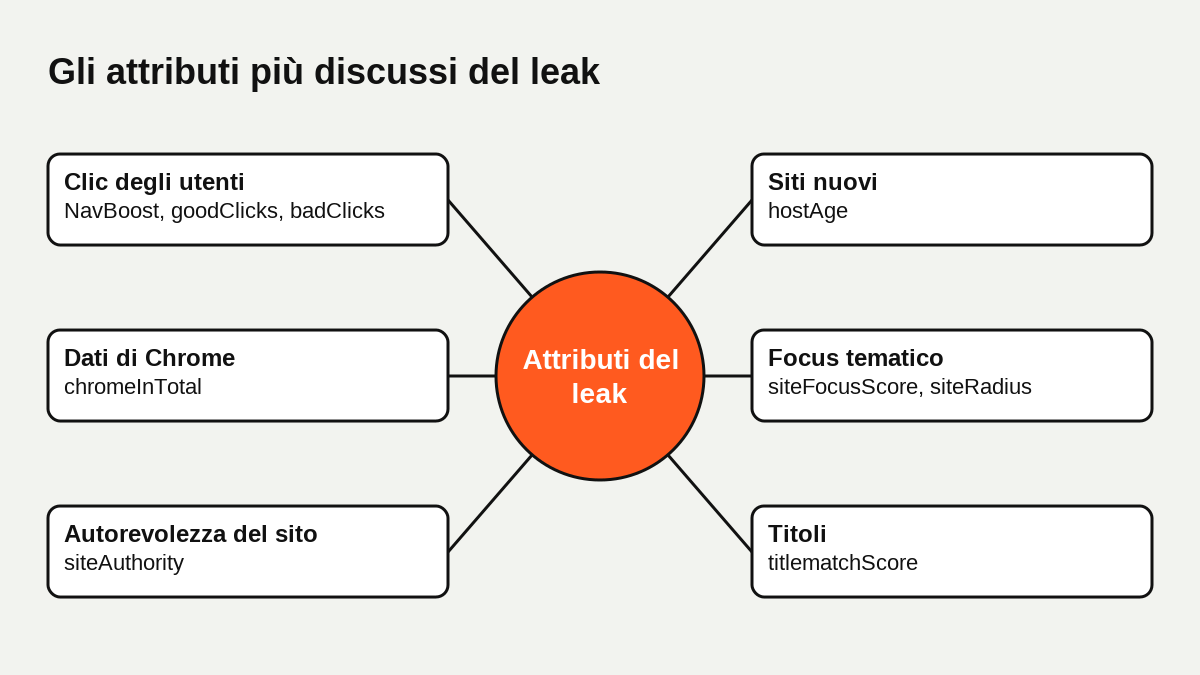
The documents describe what is recorded about a page, a site, links and user behavior. These are the points that made the most noise, with the attribute name as it appears in the files. For the big picture of how these systems work, see the guide on how Google really works.
| Topic | Attributes or modules | What they describe |
|---|---|---|
| User clicks | NavBoost, goodClicks, badClicks, lastLongestClicks | Signals based on clicks and impressions: "good" and "bad" clicks, the longest click of a search. NavBoost is mentioned 84 times and has five modules carrying its name. |
| Chrome data | chromeInTotal | Site-level views collected by Chrome. Fishkin also cites the use of browsing data to choose sitelink URLs. |
| Site authority | siteAuthority | A site-level authority value, stored among the compressed quality signals. |
| New sites | hostAge | Host age, used according to its description to "sandbox fresh spam." |
| Demotions | Panda, anchor mismatch, exact match domain, product review, location, porn | Penalties applied after the first ranking: low-quality content, link text inconsistent with the page, exact-match domains, weak reviews. |
| Result reordering | Twiddler | Functions that adjust the ranking after the first calculation, for example NavBoost, QualityBoost and RealTimeBoost. |
| Links | sourceType, phraseAnchorSpamDays | Links classified into three quality tiers; suspicious spikes of spammy anchor text. |
| Topical focus | siteFocusScore, siteRadius | How concentrated a site is on one topic and how far each page drifts from the site's average topic. |
| Titles | titlematchScore | How well the title matches users' searches. |
| Dates | bylineDate, syntacticDate, semanticDate | The date stated on the page, the one derived from the URL or title, and the one estimated from the content. |
| Authors | author, isAuthor | The authors of a document and whether an entity is the author. |
| Small sites | smallPersonalSite | A score for the "promotion of small personal sites." It is not known in which direction it is used. |
| Human raters | EWOK, golden | Quality rater data and hand-labeled reference documents, used at least in evaluation processes. |
| Sensitive topics | Flags for COVID, elections, travel | References to lists of sites for sensitive searches. |
Two details connect to other articles on this blog. The demotion called Panda confirms that the criteria of the old Google Panda live on inside the core systems. And the attributes on spammy anchor text are the modern version of what Google Penguin used to do.
Google's denials put to the test
The leak made noise mainly because some attributes seem to conflict with what Google had said in public over the years. Four cases are discussed the most.
| What Google said | What appears in the documents | How I read it |
|---|---|---|
| Clicks are not used for ranking | NavBoost and the attributes on good and bad clicks | NavBoost had already emerged in the US antitrust trial (see the entry on NavBoost and user signals). Clicks are used to reorder results, not to reward whoever collects the most of them at any cost. |
| There is no "domain authority" | siteAuthority | Google does not use the metric of an external tool, but a site-level value does exist. The two statements are compatible. |
| There is no sandbox for new sites | hostAge, used against fresh spam | It does not prove a sandbox for all new sites. It proves a cautious treatment of suspicious young domains. |
| Chrome data is not used for ranking | chromeInTotal and browsing data for sitelinks | This is the least clear point. The data is collected; how much it weighs we do not know. |
To me the point is this: many of Google's statements were worded cautiously, and the documents alone do not say whether they were false or just incomplete. The lesson is about method: official statements are a starting point, then you need tests.
What the documents do not say
A lot of exaggeration has been heard about the leak. The limits were made clear by the authors of the first analyses themselves:
- No weights. It does not say how much one attribute counts compared to another. A list of 14,014 fields is not a list of 14,014 ranking factors.
- No guarantee of use. Some attributes may be deprecated, used only for testing, or never used.
- No code. It is API documentation, with references to internal pages that cannot be opened from outside.
- A dated snapshot. The documents describe Search as it was before May 2024. Since then Google has released several core updates and brought AI into the SERP.
Fishkin himself presents them as a strong indication, not proof. Anyone selling you "the secret factor from the leak" is selling an interpretation.
What changes in practice for SEO
The documents do not show how much each attribute weighs or whether it is still in use, so here you will not find rules but working hypotheses, which are my own reading. For each one there is the attribute it comes from:
- A title consistent with the search. There is an attribute, titlematchScore, that measures the match between title and query. We do not know how much it counts, but writing a title that contains the topic of the search costs nothing.
- A page that ends the search. The documents record good clicks, bad clicks and the longest click. How they are used is not stated: it is a good reason to put the answer in the first lines.
- A clear site topic. siteFocusScore and siteRadius suggest that topical consistency is measured. The hypothesis is that publishing unrelated articles to grab traffic does not help.
- Brand. Fishkin gives a lot of weight to this point in his analysis. It is his interpretation: the documents do not measure how much the brand affects ranking.
- Links. The documents talk about link quality tiers and spammy anchors. Whether this means a link from a page with no visits is worth little has not been demonstrated.
- Consistent dates. There are three dates per page (declared, from the URL, estimated from the content). It is plausible that they are compared, and in any case changing the date without really updating the page is pointless: Google advises against it in its guidance on helpful content.
- Declared authors. The attributes on authors exist. Signing with a real name and an author page costs little, but the leak does not prove it is a ranking factor.
None of these points is a discovery: they are things Google has been asking for years from anyone who creates content for people. The leak adds the technical names, not the proof.
After the leak: AI Overviews and AI Mode
The published analyses of the documents report no references to AI Overviews or AI Mode, so they say nothing about how those features work. For the current state, see Google's page on AI features in Search: to appear as a supporting link in AI Overviews and AI Mode, a page must be indexed and eligible to show a snippet, with no additional technical requirements. Both features use "query fan-out," meaning they send several related searches at the same time. Traffic that comes from them is counted in the Search Console performance report, under the "Web" search type.
The module summary, translated into Italian
In the summary I prepared you will find the modules present in the documents. Many appear several times, in different documents and with different functions: that is why next to each module name you will find the occurrence density, meaning how many times it appears in the leaked documents. I translated the module descriptions into Italian so Italian readers can go through them without the technical English of the original documentation. Note that the summary itself is in Italian; the original documentation is in English.
Download the Italian summary of the Google Leaks
The document is very large, so I split it into several sheets, all reachable from the link above.
How to read the summary
- The title is the module name used by the developers; in parentheses is the number of leaked documents in which it appears.
- Right after it you will find the description of the whole module, that is, what it is for.
- Finally there is the description of each individual element of the module and the function it performs.
One tip: search the sheet for the names in the table above (NavBoost, siteAuthority, titlematchScore) and read the full descriptions. You form your own opinion instead of trusting newspaper headlines. If you are just starting out and want the basics first, begin with the guide on what SEO is.
If you want a first read of your site, you can request an SEO audit.
Frequently asked questions
What is NavBoost?
It is a Google system that uses click and impression data to reorder results. In the leaked documents it is mentioned 84 times, along with attributes such as goodClicks, badClicks and lastLongestClicks. According to Pandu Nayak's testimony in the antitrust trial, click data is evaluated over a period of 13 months.


