
SEO Expert (SEO Specialist): Who They Are, What They Do and How to Become One
Who an SEO expert (SEO Specialist) is, what they do every day, the skills needed, a practical 90-day path with free tools and how much they earn.

Eugenio Tommasi
Founder of SEO SRL
Published 8 min read

An SEO expert, or SEO Specialist, is the digital marketing professional who optimizes websites for search engines, through technical and content work, to increase their organic visibility, traffic and conversions.
Table of contents (5 sections)
To become an SEO expert you start with the basics, but what matters most is hands-on practice on your own site. The path I suggest lasts 90 days and uses free tools.

Who is an SEO expert (or SEO specialist)
SEO expert, SEO specialist and SEO consultant are often used as synonyms: they all refer to someone who improves a website's visibility on search engines, to increase organic traffic and the quality of visitors. A consultant works closely with the client, but the core job is the same. An SEO manager is different: they usually coordinate the team and are accountable for the strategy more than for individual optimizations.
The job needs both a technical side (site structure, speed, HTML tags, sitemap) and an editorial side: useful content that answers the questions of people searching. You can't improvise it, and search engines keep changing: you have to keep up with new trends.

What an SEO expert does: the main activities

The goal is to turn organic traffic into leads and sales. To get there, an SEO expert works on five fronts:
- Keyword analysis: identifies the words and phrases users type to find information on the site's topic and uses them to decide which content to create and how to optimize it. This is the work of keyword research.
- Quality content: creates or improves unique, relevant and useful content that answers users' questions and follows search engine guidelines.
- Natural links: earns links from other sites thanks to content worth citing and to its promotion on social media and other channels, to increase the site's authority.
- Technical optimization: takes care of HTML code, loading speed, link structure and the mobile version of the site.
- Performance analysis: measures traffic, rankings and conversions with analytics tools, to understand what works and where to intervene.
Typical services also include technical advice on hosting, redirects, error pages and JavaScript, training, expertise in specific markets and geographic areas and, more recently, generative AI optimization: today an SEO expert also works to get the site found and cited in the answers of AI search engines.
The day-to-day work, in practice
- Titles and meta descriptions. Writes titles and descriptions that convey the content and encourage clicks. There is no fixed length limit: Google truncates titles and snippets when needed, generally based on screen width, and may rewrite them. The old "55 characters" or "580 pixels" rules are just practical guidelines.
- Content structure. Organizes the site by topic and pages with clear H1, H2 and H3 headings, so users and search engines immediately understand what a page is about.
- Images. Uses short, descriptive file names, alt text that describes the image without stuffing it with keywords, and compressed files, because images often weigh more than everything else on the page. Google sets no maximum file size.
- Internal links and sitemap. Checks that every important page is reachable through internal links and included in the sitemap.
- Mobile version and speed. Google indexes and ranks sites using the mobile version of pages (mobile-first indexing): content and links must be there on smartphones too, with reasonable loading times.
- Site crawling. Periodically runs a crawler on the site to find errors, redirects, duplicate pages and missing titles: this is the core of an SEO audit.
- Competitors and backlinks. Studies who ranks on the first page for the searches that matter and which sites link to the site and to its competitors, to see what is missing.
- Editorial plan. Decides which content to create or update, in what order and for which searches, together with the writers.
Indexing and ranking: the difference

These are two stages an SEO expert needs to know well. First comes crawling, in which search engines explore the site with their crawlers, or spiders; then indexing, in which they analyze the pages and store them in their database: only then can they show them in the search results. To help both, you need a well-structured site, internal links that reach all the important pages, pages that respond correctly and are not blocked by robots.txt or noindex. Titles, meta descriptions and ALT attributes help convey the content, but they don't decide indexing, and Google does not guarantee it will index every page.
Ranking is the position a page holds in the organic results for a specific search, for example "Italian restaurant in Milan". It depends on the relevance of the content, the quality of incoming links, the site structure and the correct use of keywords: pages in the top results get more visibility and more clicks.
How to become an SEO expert: a 90-day path
You don't need a specific degree: people come to this job from studies in communication, marketing, computer science or languages, from a master's in digital marketing or from an internship at an agency next to a senior SEO. Skills matter more: understanding how search engines crawl and index, a bit of HTML and CSS, being able to read data, writing clearly and understanding what people really search for. If you also work on paid campaigns, you can add the Google Ads certification, which is a study foundation and not proof of practical skill.
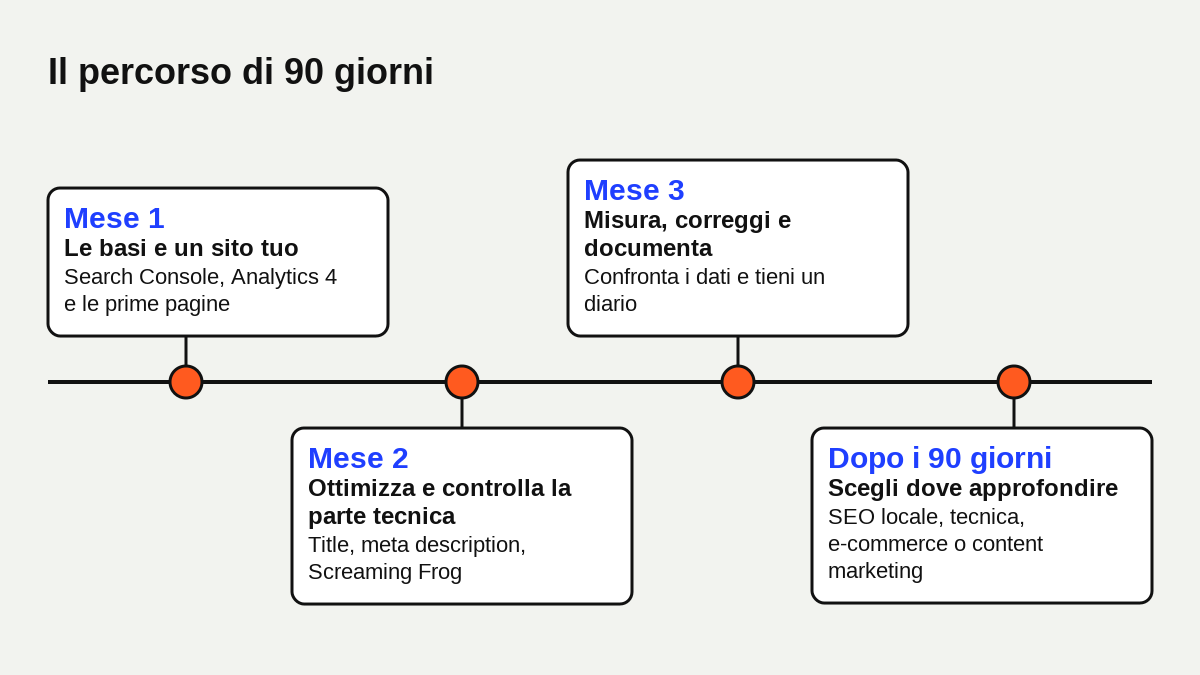
You learn SEO by doing it, on a site where you can change everything. The plan lasts three months and uses free tools. The timing is indicative: it depends on how much time you dedicate to it.

Month 1: the basics and a site of your own
- Read Google's SEO Starter Guide and, alongside it, the basics of SEO.
- Start a site or blog on a topic you know: a blog, a small shop, whatever you like, as long as you have complete control over it.
- Connect the site to Google Search Console and Bing Webmaster Tools, and install Google Analytics 4. Search Console shows queries, impressions, clicks and average position; data arrives after a few days, so do it right away.
- Publish the first four or five pages, each on a specific question. Write them for the reader: there is no minimum or maximum word count.
Month 2: optimize and check the technical side
- Open the Search Console performance report and see which searches your site appears for. Use them to decide what to write next: it's a simple way to do keyword research with your own data.
- Review titles, meta descriptions, H1-H3 headings, image alt text and internal links on every page.
- Run the site through Screaming Frog (the free version crawls up to 500 URLs) and note errors, redirects, duplicates and missing titles: it's the skeleton of an SEO audit.
- Check the sitemap and speed with PageSpeed Insights, on smartphone too.
Month 3: measure, fix and document
- Compare the Search Console data with that of the first month. Some changes take effect within hours and others take months: wait a few weeks before judging them, and don't judge after three days.
- Take the pages with many impressions and few clicks and rewrite their titles and descriptions. Then, after a few weeks, see what has changed.
- Try an audit on an acquaintance's site, with their permission, and write a short report: the problem, why it matters, what you would do.
- Keep a log of what you changed and what happened. An expert is judged by work samples, real cases and references: the log is your first portfolio.
After the 90 days
Choose where to go deeper: local SEO, technical SEO, e-commerce, or SEO copywriting and content marketing. If you work with clients, also work on the relationship side: measurable goals, clear expectations, understandable reports.
To stay up to date, start with the Google Search Central blog and the Search ranking updates page: they are the official source on new features and core updates, and they save you from chasing unconfirmed rumors. Then Search Engine Journal, the Moz blog and the Ahrefs blog, and SEO communities. To optimize for the answers of AI search engines, see the guide to generative engine optimization.
Certifications and courses
You don't need an official qualification to work as an SEO expert. There are related courses and certifications, such as those from Google Analytics, Semrush Academy or HubSpot: they are a plus on your resume, not a requirement.

How much an SEO specialist earns
In Italy there is no official statistic on SEO salaries. The available estimates are based on job ads and reports, are indicative and don't always agree. Randstad gives an average of about 30,000 euros gross per year for an SEO specialist, about 28,000 for beginners and over 33,000 for an experienced profile. Jobicy, based on job ads with data from October 13, 2026, estimates in dollars about 21,800-30,300 for a junior, 30,600-45,800 between 3 and 5 years of experience and 46,400-64,700 beyond 6 years.
Experience, city, type of company (an agency serving large clients usually pays more than a small local business), languages and team or client responsibilities all matter. For freelancers there is no reliable public data: revenue depends on experience, portfolio and network of contacts, and should be compared with an employee's gross salary by taking into account taxes, social contributions and periods without clients.
Frequently asked questions
How long does it take to become an SEO expert?
It depends on your starting point and how much time you dedicate to it. The 90-day path above gives you the practical basics, but to see the effect of your choices you need to follow a site for months: some changes take effect within hours, others take several months.
Is someone who promises the first position on Google a reliable expert?
No. Nobody can guarantee reaching the first position in Google's results: be wary of anyone who promises a specific ranking, claims a special relationship with Google or advertises priority inclusion. A serious expert talks about measurable goals, such as organic traffic, leads or sales, and explains how they intend to reach them.
