
Content Marketing: What It Is and How to Build a Strategy That Brings Clients
Content marketing is not about writing more: it is about answering customers’ questions better on Google, in AI answers and on LinkedIn. A 7-step strategy, an editorial plan and 6 KPIs.

Eugenio Tommasi
Founder of SEO SRL
Published 13 min read

Content marketing is marketing done through content: guides, articles, videos, newsletters, case studies and posts that answer customers’ questions before they are ready to buy.
Table of contents (9 sections)
- What is content marketing: meaning and definition
- Three numbers that help you decide
- Content marketing and SEO: how they fit together (including AI answers)
- Content marketing strategy in 7 steps (with a complete example)
- 6 formats that work for small businesses: pros and cons
- How to measure content marketing: 6 KPIs in GA4 and Search Console
- 7 mistakes that make content marketing fail
- Where to start
- Frequently asked questions
Key takeaways
- Content marketing uses useful, consistent content to attract a specific audience and lead it to a purchase, not just to generate traffic.
- Among B2B marketers who use AI for content, 87% see higher productivity, but only 39% see content that performs better.
- For 76% of B2B marketers, LinkedIn is the most effective channel for thought leadership.
- On informational queries with an AI Overview, cited pages get 120% more clicks per impression than pages that are not cited.
- AI traffic can now be measured: the AI Assistant channel in GA4 since May 2026, and AI impressions in Search Console rolled out to all sites from August 31, 2026.
Advertising is rented attention: it disappears when the budget runs out. Content marketing builds an asset you own, one that works on Google, in AI answers and on LinkedIn. Below is the 7-step strategy I use, with an editorial plan, how to use AI without losing quality, and 6 KPIs to track.
What is content marketing: meaning and definition
Content marketing is marketing done through content: guides, articles, videos, newsletters, case studies and posts that answer your customers’ questions before they are ready to buy. When they are, they already know you.

The reference definition comes from the Content Marketing Institute: a strategic marketing approach focused on creating and distributing valuable, relevant and consistent content to attract and retain a clearly defined audience and, ultimately, drive profitable customer action.
What it is not: advertising, SEO alone, “just posting”
- It is not advertising. Advertising buys attention and stops when you stop paying. Content marketing, instead of pitching products and services, offers useful content that helps customers solve their problems.
- It is not SEO alone. SEO makes content findable. Content marketing decides which content to create, for whom and with what goal. An optimized but useless page does not sell.
- It is not “just posting”. Publishing without a goal, distribution and measurement is activity, not strategy.
B2B and B2C content marketing: what changes
In B2B the sales cycle is long and several people take part in the decision: the owner looks at return, the technician at specs. You need content for each of them and channels such as LinkedIn, newsletters and webinars. In B2C the cycle is shorter and proof matters: videos, reviews, comparisons.
Content marketing examples for small businesses
- Window and door company: a guide “PVC or aluminum: how to choose”, installation videos, a checklist for reading a quote.
- Accounting firm: a monthly newsletter on deadlines, a page with clients’ frequently asked questions, a webinar for people registering for a VAT number (in Italy, a partita IVA).
- Cosmetics e-commerce: a sensitive-skin routine guide, short application videos, results of a customer survey.
Three numbers that help you decide
They help you choose how to produce, where to distribute and how to write.
| Data point | Source |
|---|---|
| Among B2B marketers who use AI for content: 87% higher productivity, 58% higher quality, 39% content that performs better | CMI |
| LinkedIn is the most effective thought leadership channel for 76%, newsletters 54%, webinars 52% | CMI |
| On informational queries, pages cited in AI Overviews get 120% more organic clicks per impression than pages that are not cited, but remain 38% below queries with no AI Overview | Seer Interactive, 53 brands |
How I read it. AI has solved the “how much” of writing, not the “what.” Your website remains the foundation, LinkedIn is the B2B megaphone, and in AI answers the winner is whoever gets cited.
Content marketing and SEO: how they fit together (including AI answers)
SEO puts your content in front of people who are searching; content marketing decides what to say, to whom and why. Both are channels of a broader digital marketing strategy, which also includes ads and email. And it is the engine of inbound marketing, the model that guides readers all the way to contact and sale.
What Google rewards. Its ranking systems are designed to prioritize helpful, reliable information created for people, not content created to manipulate rankings. The 2026 core updates, in March and May, point the same way: surfacing relevant, satisfying content from sites of every kind. If you already create content designed for people, you are headed in the right direction.
AI Overviews: fewer clicks, but cited pages get more. With an AI Overview, organic CTR drops. Pages that are cited still get more clicks than pages that are not, as the table above shows.
Cover the topic, not a keyword. A 2026 Ahrefs study found that about 38% of AI Overview citations come from pages in the top 10 for the same search, versus 76% in 2025 (samples not directly comparable). One explanation is query fan-out: Google splits the question into several sub-questions and cites whoever answers those well.
No tricks for AI. SEO best practices still apply to generative AI features: you do not need AI-specific files, special markup or chopped-up text, you need unique, helpful and reliable content. I explain how Google’s answers work in the guide to AI Overviews.
What makes content citable, by Google and by AI:
- Answer first: 2-3 clear sentences under every heading.
- Data with a source and a period, ideally your own.
- First-hand experience: evidence, photos, real prices.
- A recognizable author: content written or reviewed by an expert or an enthusiast who really knows the topic.
- Real updates, not just a changed date.
If your blog is not bringing visits, start with the guide to blog SEO to get visibility.
Content marketing strategy in 7 steps (with a complete example)
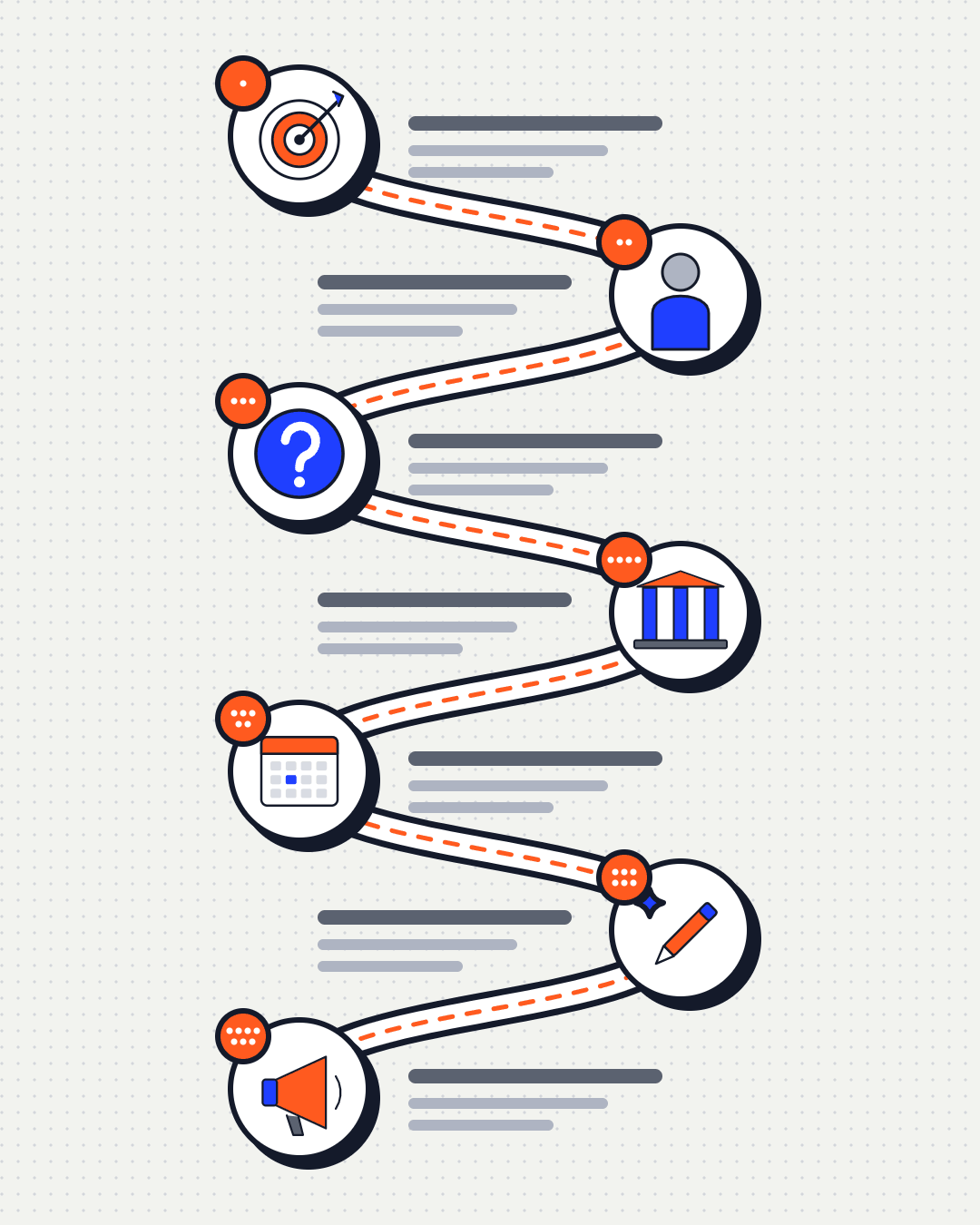
Here is an example from start to finish: a window and door company with 30 employees that sells PVC and aluminum windows to homeowners and construction companies. Today its quote requests come almost entirely from word of mouth.
1. Set a business goal, not a traffic goal
Visits and likes do not pay salaries. Tie your content to a number that matters: quotes, demos, sign-ups, sales. Write it down with a starting point and a deadline.
Example: going from 5 to 30 quote requests a month from the website in 12 months, at a lower cost per request than ad campaigns.
2. Define your audience and buyer personas
A buyer persona is a portrait of your typical customer: who they are, what they want to achieve, what they fear, how they decide. Build it with real data: questions from your sales team, lost quotes, emails, reviews.
Example: three buyer personas.
- Homeowner renovating: wants lower energy bills, fears surprises in the quote.
- Construction company or surveyor: looks for firm timelines, technical data sheets, well-done installation.
- Building manager: has to get the expense approved at the owners’ meeting.
3. Find your customers’ real questions
Nobody searches for “quality windows and doors.” People search for answers: “PVC or aluminum?”, “how much does it cost to replace windows?”. Collect questions from four sources:
- Search Console: the searches you already appear for.
- The SERP: search suggestions, related questions, titles of the top results.
- Sales and support: the questions that come in every week.
- AI assistants: ask ChatGPT or Gemini what your customer would ask and see who gets cited.
Then assign each question an intent: learn, compare, buy.
4. Choose your pillars and formats
Group the questions into a few pillars, usually 3-5: the topics on which you want to become the reference. As a rule, each pillar has one main guide and 6-10 linked in-depth articles.
Example: four pillars.
- Choosing windows and doors: materials, insulation, security.
- Costs and quotes: what makes the price vary, how to compare two offers.
- Installation and maintenance: installation mistakes, seasonal care.
- Case studies: apartment building, house, shop.
For the format, look at the SERP: if Google shows videos, make videos; if it shows guides, write guides.
5. Create the editorial plan (with a template)
The editorial plan turns your pillars into a calendar. A spreadsheet with 8 columns is enough. This is the first month of the example:

| Week | Content | Search question | Pillar | Stage | Format | CTA | Distribution |
|---|---|---|---|---|---|---|---|
| 1 | PVC or aluminum: how to choose | pvc or aluminum windows | Choosing | Comparison | Guide + short video | Book a site visit | Website, LinkedIn, newsletter |
| 2 | Window quote: 9 items to check | window quote | Costs | Decision | Guide + PDF checklist | Download the checklist | Website, email to contacts |
| 3 | New windows in an apartment building: how the decision is made | windows apartment building | Case studies | Decision | Case study | Talk to the technical office | LinkedIn, sales team |
| 4 | 5 installation mistakes that let air in | window installation mistakes | Installation | Awareness | Short video + article | Book an inspection | Social, website |
Choose a pace you can keep up for 12 months: two strong pieces a month beat twenty in January and then silence. On the crypto and blockchain portals I have worked on, stable guides and linked news pieces took Google clicks from a few hundred to 30,000-40,000 a month, in steps and over a few years.
6. Produce content with AI, without losing quality
Every piece starts from a brief: main question, subheadings drawn from the SERP, data, an expert to interview, CTA. Then AI comes in.
Google does not ban it. Appropriate use of AI or automation is not against Google’s guidelines, which have said so since 2023. But using it to generate many pages with no added value can violate the spam policies (scaled content abuse). On October 1, 2026 Google updated its guidance on using generative AI: any AI-generated content should be checked and reviewed by hand before publishing, metadata included.
The data confirms it. In 2025 Ahrefs analyzed 600,000 pages: the amount of AI in the text is not related to ranking position.
Split the work like this:
- To AI: ideas and headline variants, an outline from the brief, a first draft of descriptive sections, summaries, adaptations for LinkedIn and newsletters.
- To people: first-hand experience, data and evidence, examples, opinions, verification of every number, brand voice, final approval.
Before publishing, answer the three questions Google asks about content: who wrote it, how (is it clear to readers if you used automation?) and why (to help people?).
7. Distribute and repurpose
Publishing is not enough. From each main piece you can usually derive 5-8 spin-offs: a newsletter to your contacts, the channel you truly own (see the guide to email marketing); 2-3 LinkedIn posts from the owner’s and technicians’ profiles; a browsable PDF document; 2 short videos of 30-60 seconds; a sheet for the sales team; internal links from your most visited pages.
Example: the “PVC or aluminum” guide becomes a newsletter, three LinkedIn posts for surveyors and construction companies, a showroom video comparing the two profiles and a PDF sheet for the sales team.
6 formats that work for small businesses: pros and cons
| Format | Pros | Cons | Example |
|---|---|---|---|
| In-depth guides | Answer many questions, attract searches and AI citations | Take time and need updating | Accountants: guide to registering for a VAT number |
| Data pages | Original numbers that other sites and AI can cite | Need real data and a transparent method | Cosmetics: results of a survey of 1,000 customers |
| Case studies | Concrete proof for people who have to decide | Need the client’s permission or anonymity | Windows and doors: new frames in a 1970s apartment building |
| Short videos | Watched and shared quickly | Short lifespan, need consistency | Cosmetics: how to apply the serum in 30 seconds |
| Newsletter | Your own channel, no algorithms | Needs a list and a reason to open it | Accountants: this month’s deadlines in five lines |
| The most effective B2B thought leadership channel for 76% of B2B marketers | Unpredictable organic reach, needs people’s personal profiles | Windows and doors: the installation detail surveyors ask about most |
Short on time? Start with guides on your site plus one channel: LinkedIn for B2B, newsletter for B2C.
How to measure content marketing: 6 KPIs in GA4 and Search Console
Six numbers are enough, read every month by pillar, not by individual article.
| KPI | Where to find it | What it tells you |
|---|---|---|
| 1. Organic impressions | Search Console, search data by page and by query | Whether Google shows you for the right questions |
| 2. Clicks and CTR | Search Console, same data | Whether titles and snippets convince |
| 3. Impressions in AI features | Search Console, new generative AI report | How often you appear in AI Overviews, AI Mode and Discover, by page, country and date |
| 4. Organic sessions on content | GA4, landing pages filtered by the Organic Search channel | How many visits your content brings |
| 5. Traffic from the AI Assistant channel | GA4, traffic acquisition | Visits from ChatGPT, Gemini and other recognized assistants |
| 6. Key events generated by content | GA4, key events (formerly called conversions) | Quotes, sign-ups, downloads: the number that pays |
Three practical notes:
- The Search Console AI report was extended to all sites on August 31, 2026 (sites with few AI impressions may not see it), but for now it shows impressions without clicks.
- The AI Assistant channel has existed in GA4 since May 13, 2026 but does not see everything: AI Overviews and AI Mode stay in Organic Search, and visits with no referrer end up in Direct. For the full history you need a custom channel group based on source.
- The KPI that decides is the sixth. The others tell you where to intervene. For the window and door company, it is the quote requests that come from content.
7 mistakes that make content marketing fail
- Starting from the calendar instead of the goal. Without a business number you do not know what to cut and what to double down on.
- Writing for search engines. Google’s questions about search-engine-first content point to the warning signs: lots of topics in the hope that something ranks, summaries of other people’s work with no added value, trending topics outside your expertise.
- Publishing AI text without review. More pages does not mean more traffic: you risk violating the scaled content abuse policy and you lose trust at the first mistake.
- Content with no action. Creating content that leads to action is one of the difficulties B2B marketers cite most. Every piece must end with a CTA suited to the stage: checklist, site visit, demo.
- Publishing and hoping. Without distribution nobody reads you. Plan the spin-off content before you write.
- Looking only at visits and likes. They are vanity metrics: they tell you how much you are seen, not how much you sell. Look at key events.
- Stopping after three months. Content needs to be consistent. Consistency builds trust, and in Google’s E-E-A-T, trust is the most important aspect.
Where to start
Want to know whether your content answers what your customers are searching for? Find out what is holding your site back on Google and in AI with an SEO audit.
Frequently asked questions
How long does it take to see results from content marketing?
It depends on competition, your site’s authority and your publishing pace: think in months, not weeks. Set two checkpoints. As a rough guide, after 2-3 months check in Search Console whether impressions are growing on the questions you chose. After 6-12 months, evaluate key events in GA4: quotes, sign-ups, sales. If impressions are not rising, review your topics and formats.
What is the difference between content marketing and inbound marketing?
Inbound marketing is the complete model: attracting people, turning them into leads and following them through to the sale. It therefore also includes forms, a CRM, automated emails and the work of the sales team. Content marketing is the part that produces and distributes content. It can also be done without a structured inbound funnel, for example to get known in a new market.
What is the difference between content marketing and copywriting?
Copywriting is writing that drives action: an ad, a landing page, an email subject line, a button. Content marketing is the strategy that decides which content to create, for whom and on which channels. Within a content strategy, copywriting works at the conversion points, such as headlines and CTAs. A useful guide with a weak call to action brings readers but few leads.
Who should handle content marketing in a small business?
You rarely need a full-time dedicated person. You need an owner who keeps the editorial plan and checks the numbers, plus in-house experts (owner, technicians, salespeople) who provide answers and examples. Writing, graphics and video editing can be handed to a freelancer or an agency. Expertise, however, cannot be delegated: without the company’s own experience, your content ends up looking like everyone else’s.

