
Google Reviews: How to Get, Answer and Remove Them Within the Rules
In 2026 the rules for asking for Google reviews changed twice: in April Google tightened its policies, and in Italy Law 34/2026 came into force for restaurants and tourism.

Eugenio Tommasi
Founder of SEO SRL
Published 13 min read

Google reviews are the star ratings and comments that customers leave on a business's Google profile: they guide consumer choices and affect rankings in local search.
Table of contents (9 sections)
- Why Google reviews matter
- The rules: what is banned (and what is not)
- How to get Google reviews: 7 legitimate methods
- How to reply to reviews: 5 rules and 3 templates
- How to report and remove a Google review
- Fake reviews: how to spot them and defend yourself
- Reviews on your website: markup and limits (what Google shows and what it doesn't)
- 5 mistakes to avoid with Google reviews
- Frequently asked questions
Summary
- In 2025 Google blocked or removed over 292 million reviews that violated its policies.
- Since April 17, 2026, Google also bans review quotas for staff and requests to name an employee, on top of incentives and review gating.
- In Italy, since April 7, 2026, a review of a restaurant or tourism business is lawful only if it is written within 30 days of using the service, by someone who actually used it and without any benefit in return (Law 34/2026).
- 89% of US consumers expect a reply from the business owner.
- Google removes only reviews that violate its policies, not negative ones.
In 2026 the rules for asking for reviews changed twice. If you get it wrong, you risk deleted reviews, restrictions on your profile and fines. There are 7 legitimate ways to get reviews, and below you will also find 3 reply templates and the removal procedure.
Why Google reviews matter
Reading and trust: the numbers
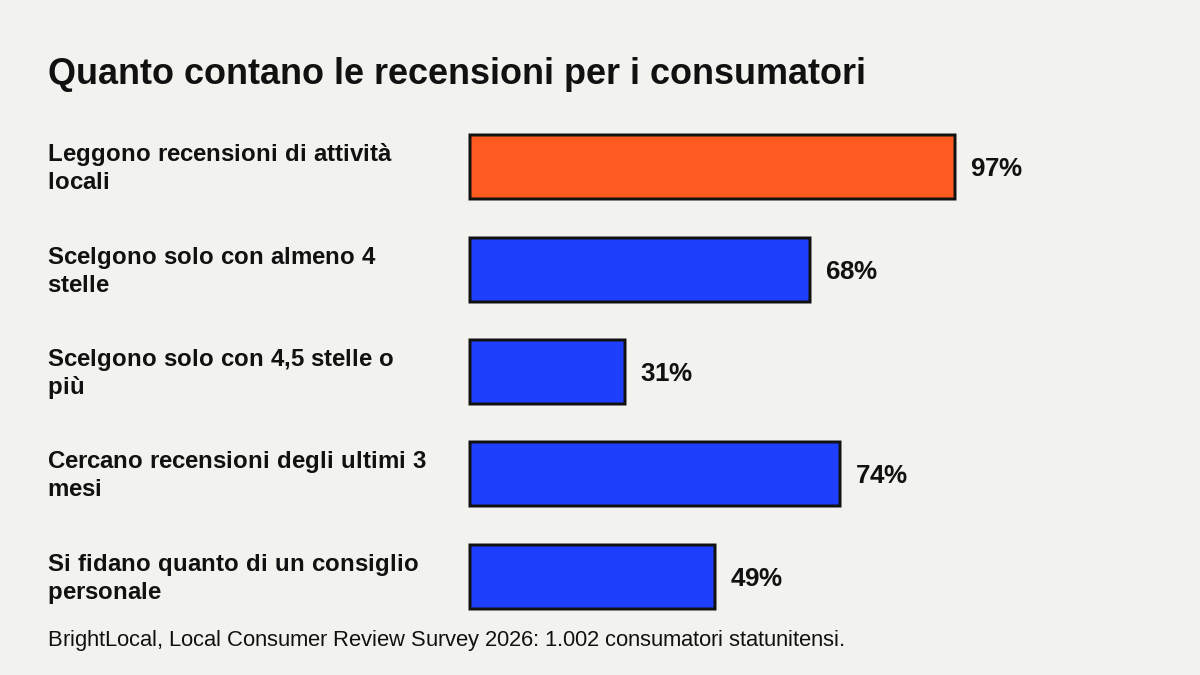
The 2026 Local Consumer Review Survey by BrightLocal (1,002 US consumers, February 2026) gives these figures:
| Consumer behavior | Share |
|---|---|
| Read reviews of local businesses | 97% |
| Only choose businesses with at least 4 stars | 68% |
| Only choose businesses with 4.5 stars or more | 31% |
| Look for reviews written in the last 3 months | 74% |
| Trust reviews as much as a personal recommendation | 49% |
| Read AI-generated review summaries | 82% |
Google is still the top platform for reviews (71%), but the share of people using ChatGPT or other AI tools to find local businesses has climbed from 6% to 45%. I explain how Google's AI picks its sources in the guide to AI Overviews.
Reviews and local ranking
Local results depend on relevance, distance and prominence, and more reviews and positive ratings improve a business's ranking. Rankings cannot be bought. What Google's local search patents do and do not say is covered in the dedicated article.
In the 2026 Whitespark report (47 local SEO experts, November 2025), for the Local Pack a high Google rating ranks 6th, the number of reviews with text ranks 9th and their freshness 11th.
Example: two restaurants on the same street, one with 4.2 stars and a last review eight months old, the other with 4.6 and a new review every week. The first is out of the running for anyone who only picks 4.5 and up, and it has nothing recent to show. Reviews are one piece of local SEO, alongside your profile, category and website.
The rules: what is banned (and what is not)
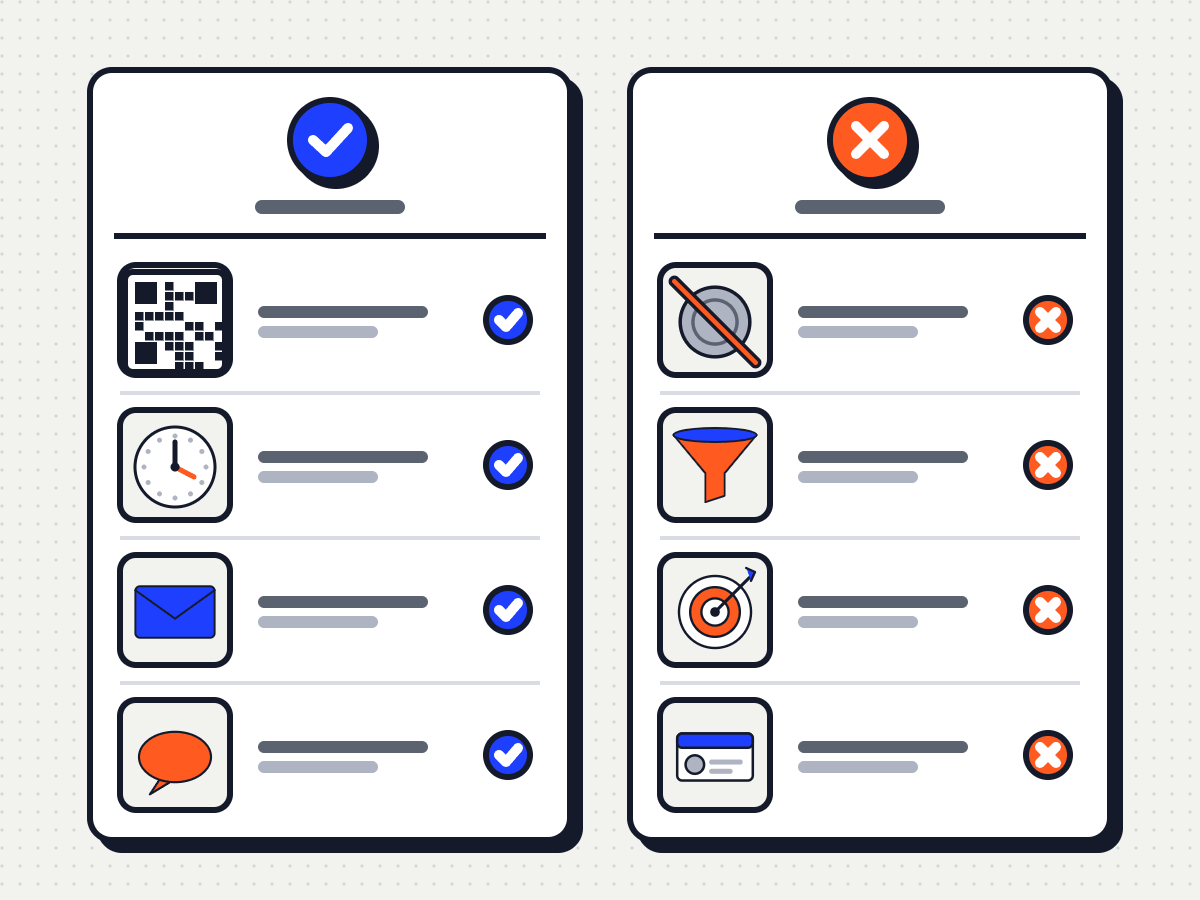
Google's policies as updated in April 2026
On April 16, 2026, Google released its 2025 figures: over 292 million reviews blocked or removed and over 13 million fake profiles taken down. On April 17, two new bans appeared in the Maps policies. Today the Google Maps policies prohibit merchants from:
- offering incentives (money, discounts, free products or services) in exchange for a review;
- asking staff to solicit "a certain number of reviews" (new);
- asking staff for reviews with specific content, including an employee's name (new);
- discouraging negative reviews or soliciting only positive ones: this is review gating;
- pressuring customers to leave a review while they are on the premises.
Conflicts of interest are also banned: employees, former employees, relatives, competitors. Violators risk having new reviews blocked, existing ones hidden and a public warning on their profile.
Italy's online reviews law for restaurants and tourism
Law no. 34 of March 11, 2026 (Official Gazette no. 68 of March 23, 2026) has been in force in Italy since April 7, 2026. Chapter IV, "Fighting fake reviews," covers restaurants, tourist accommodation (including hotels and spas) and tourist attractions in Italy:
- 30 days, 2 years. A review is lawful if it is written within 30 days of the date the service was used (art. 19), by the person who used it. Two years after publication, it no longer is.
- No benefits. It must not result from discounts, perks or other benefits from the business or its intermediaries.
- Proof. It is presumed authentic if accompanied by evidence of a tax document, such as a receipt.
- Reporting. The legal representative can report unlawful reviews to the platform to have them removed, using the procedure in art. 16 of the Digital Services Act.
- Buying and selling banned. Buying and selling reviews is prohibited (art. 20); the Italian Competition Authority (AGCM) enforces this.
- Not retroactive. It does not apply to reviews published before April 7, 2026.
Operational guidelines are up to the AGCM, which at the end of June opened a public consultation on a draft running until July 15, 2026. As of October 1, 2026, only the draft existed, not the final text.
The Italian Consumer Code applies to everyone
Under the Omnibus Directive, Italy's Consumer Code treats it as "misleading in all circumstances" to claim that reviews come from real customers without reasonable checks, and to submit or commission fake reviews (art. 23, letters bb-ter and bb-quater). And stating whether and how you verify reviews is material information (art. 22, paragraph 5-bis).
Allowed and banned practices: the table
| Practice | Allowed or banned | Source |
|---|---|---|
| Asking everyone for a review, with a link or QR code | Allowed | |
| Discount, freebie or prize in exchange | Banned | Google; Law 34/2026 (unlawful review) |
| Asking only satisfied customers | Banned | |
| Review quotas for staff | Banned since April 17, 2026 | |
| Asking customers to name an employee | Banned since April 17, 2026 | |
| Having the review written on the premises, in front of staff | Banned | |
| Reviews from employees, relatives, competitors | Banned | |
| Buying or selling reviews | Banned, punishable by the AGCM | Law 34/2026; Consumer Code |
| Review of a restaurant or hotel written more than 30 days after use | Unlawful, can be reported | Law 34/2026 |
| Reviews on your website without saying whether you verify them | To be avoided | Consumer Code |
How to get Google reviews: 7 legitimate methods
The principle is simple: ask everyone, in the same way, give nothing in return and do not influence the rating or the text. Not "leave us 5 stars": ask how it went.

1. Use the direct link from your Profile
On a computer, open your Business Profile and choose "Read reviews," then "Get more reviews" and "Copy." The link takes the customer straight to the review form.
Example: an accounting firm adds it to the email it sends when delivering a tax return.
2. Print the QR code
From the same panel you can download the QR code, for now only on a computer. Displaying it on the premises is fine; having the review written there, in front of staff, is not.
Example: a restaurant prints the QR code on the card that comes with the check.
3. Pick the right moment
Ask within a few days of the visit, while the memory is fresh. In Italian restaurants and tourism the law matters too: a review is lawful only if the customer writes it within 30 days of using the service (not from your request), so don't wait. Aim for a steady flow, because 74% of people look at the last three months.
Example: a hotel sends the request the day after check-out, not at the end of the season.
4. Ask all customers the same way
Same message, same moment, for everyone. A mix of positive and negative feedback often looks more trustworthy.
Example: a dental practice sends the same text message to all patients after the appointment, not just to those who left happy. For dental practices, healthcare advertising rules also apply, which I explain on the page about marketing for dentists.
5. Put the request in messages you already send
The Profile link or QR code can also be shared by email, WhatsApp or Facebook: put it in the thank-you email or the end-of-service message. One sentence is enough: "Thank you for choosing us. If you like, tell us on Google how it went." Then the link.
Example: a cleaning company adds it to the WhatsApp message sent at the end of a job.
6. Train staff, with no quotas and no names
Staff can remind everyone about the review. But no numerical targets, contests or prizes, and no requests to mention their own name.
Example: in a hair salon, the front desk gives every customer a card with the QR code, with no leaderboards among colleagues.
7. For e-commerce: Google Customer Reviews
A Merchant Center service: after a purchase, the customer can opt in and usually receives an email to rate the experience. The stars appear in search results and Shopping ads.
Example: a home goods store shows the opt-in form to every customer after checkout.
How to reply to reviews: 5 rules and 3 templates
The reply is public, signed with the business name, and the author receives a notification. Google checks it before publishing: usually within 10 minutes, sometimes up to 30 days. In the BrightLocal survey, 89% of customers expect a reply from the owner, 81% within a week, and 80% are more likely to choose a business that replies to all reviews.
The 5 rules
- Reply to all, within a week. Even the positive ones.
- No copy-and-paste replies. Generic or canned replies put off 50% of consumers. Mention a detail.
- Protect data. Never surnames, order numbers or health details. A dental practice does not publicly comment on a patient's treatment.
- On negative ones: acknowledge, explain, move offline. Apologize if you made a mistake, say what you are changing, give a direct contact.
- Offer nothing to get a review changed or removed. For Google that is fake engagement. Write for your future customers.
Template 1: positive review (restaurant)
Thank you [Name], we're glad you enjoyed the grilled seafood and that the service was fast even on a Saturday night. We'll pass it on to the kitchen. See you soon!
Template 2: legitimate negative review (e-commerce)
Hi [Name], you're right: your order arrived four days after the promised date, and we're sorry. The problem was a change of courier in your area, which has already been fixed. Write to our customer service address with your order number and we'll work out how to make it right.
Template 3: fake or suspicious review (dental practice)
Dear [Name], we cannot find an appointment in our records that matches your description and, for privacy reasons, we do not go into details in public. If you were our patient, please call the number on our website: we want to understand what happened. We have asked Google to verify the review.
How to report and remove a Google review
If you are searching for how to delete Google reviews or remove negative reviews, start here: a review can be edited or deleted by its author. You can report it, and Google removes it only if it violates its policies: don't report a review just because you disagree or dislike it.

The reasons Google accepts
They fall into these categories:
- spam and fake engagement: paid reviews, multiple accounts, invented experiences;
- conflict of interest: former employees, competitors, relatives;
- off topic: political or social comments, generic rants;
- harassment, threats, personal data published without consent.
The procedure in 4 steps
- Report from your profile. "Read reviews," click the "Report" icon next to the review, choose the reason and submit.
- Or use the review management tool. Choose the option to report a new review and click "Report."
- Check the status. In the tool you will see "Pending decision," "No policy violation" or "Reassigned." Review of a report "usually takes several days."
- Appeal, once only. If Google finds no violation, you get a one-time appeal, for a maximum of 10 reviews: state factually which policy is being violated.
If Google refuses: other routes
- Reply publicly with template 3: readers also see your side.
- Legal grounds. For content that violates the law or your rights there is a dedicated Google form.
- Defamation. An offensive review spread online can amount to aggravated defamation under Italian law (art. 595 of the Criminal Code). But genuine, relevant and measured criticism is lawful: assess the case with a lawyer.
- Restaurants and tourism. Under Law 34/2026 in Italy, you report unlawful reviews to the platform: written more than 30 days after use, without real use of the service, in exchange for benefits. The AGCM steps in on buying and selling. How this applies to a restaurant's listing, website and review requests is explained on the page about marketing for restaurants.
- Extortion. A barrage of 1-2 star reviews and a demand for money to remove them? Don't pay, don't engage, collect evidence and use Google's form for extortion scams.
If it is your profile that is restricted
In May 2026 there was a spike in profile suspensions linked to restrictions on user accounts. If it happens to you, appeal with documents in which the name and address match the profile, and do not create new profiles. The decision can take up to 5 business days. In the European Economic Area you can also turn to an out-of-court dispute settlement body, as provided by the Digital Services Act. If the drop concerns your website, start with Google penalties.
Fake reviews: how to spot them and defend yourself
Google filters many of them: as early as 2022 it described a machine learning system that evaluates content, account and location, for example too many reviews in a short time. But some get through. The 5 signs to check:
- Spikes of 1-star or 5-star reviews in a few days, for no reason.
- Accounts with no history, just created or with a few scattered reviews.
- Generic text, with no details about the service, date or place.
- Impossible facts: a service you don't offer, a day you were closed.
- No match in receipts, bookings or orders.
How to defend yourself: screenshots with date and link, a check against your records, a report with the most precise reason, a calm reply.
And don't buy them. Beyond Google's restrictions and AGCM fines, there is criminal law: in 2018 the Court of Lecce sentenced the owner of an agency that sold packages of fake reviews on a travel portal to 9 months.
Reviews on your website: markup and limits (what Google shows and what it doesn't)
Showing reviews on your website helps people decide, but it doesn't always produce stars in search results. Google's review snippet guidelines, updated September 18, 2026, say this:
- Self-serving reviews. If a business publishes reviews about itself, pages with LocalBusiness or Organization markup are not eligible for stars, even with a third-party widget such as the Google reviews one.
- No aggregation. Do not include reviews taken from other sites in the markup.
- Visible on the page. Marked-up reviews must be readable by the user.
- Products yes. Reviews on product pages can earn the snippet, if the ratings come directly from users.
Then there is the transparency required by the Italian Consumer Code. One line is enough: "We only publish reviews from customers with a verified order or booking." The AGCM draft, aimed at all businesses publishing reviews for the Italian market, also asks you to explain moderation and how the score is calculated. To check markup and pages, start with an SEO audit.
5 mistakes to avoid with Google reviews
- Quotas and contests among employees. Banned since April 17, 2026.
- A filter before Google. Sending only 5-star customers to Google is review gating.
- Buying reviews. See above: restrictions, fines, criminal liability.
- Combative replies. They stay public forever.
- Reporting everything you don't like. A negative but genuine review stays.
Reviews bring clicks, but then your website decides: find out what to fix first.
Frequently asked questions
Can you delete a negative review on Google?
Not with one click: a review can be deleted by its author. You can report it from your Business Profile, but Google removes it only if it violates its policies, for example spam, conflict of interest or offensive content. If it is negative but truthful, it stays: reply publicly, calmly and with concrete facts.
How long does it take to remove a reported review?
Reviewing a report usually takes several days. You can check the status in the review management tool. If the outcome is "no violation," you can file one appeal. Requests on legal grounds and court cases take different amounts of time, depending on the case.
Can I offer a discount to people who leave a Google review?
No. Google's policies ban money, discounts, free products or services in exchange for a review, even if you ask for an honest opinion. In Italian restaurants and tourism, Law 34/2026 makes a review tied to benefits unlawful. You can only ask all customers, in the same way, to share their experience.


